
What's the inverse of the saying plus ça change, plus c'est la même chose?
A year ago, I wrote a post discussing how this blog handles media caching for the purposes of managing server overheads for hundreds of 640x480 screenshots of old PlayStation games nobody cares about. It wasn't a particularly taxing task for a web developer - in fact, it felt a little embarrassing making such a grand show of coding up something so simple - but I used it as a bit of an opportunity to talk a bit about what AI coding tools were capable of with some gentle prompt-massaging (a term far less pretentious than 'prompt engineering'), as well as a springboard to speculate on what happens next for your old fashioned software dev, who until then had surely thought that the industry they were in would remain as in-demand and futureproof as they come for a good while yet.
It's weird to read back now. I was talking about using an IDE-integrated chat bot to autonomously code up bits of functionality that were little more than widgets, and marvelling at the result. I engaged in some virtual tête-à-tête, asking why it had chosen this type of object over another, tweaked its approach a bit, then examined the results, tried to run it and found a bug. It got the job done, in much quicker order than I would have managed it on my own, but I still needed to be 'in the code' in order to be confident it was all going to work.
In The Code, to Out Of The Code, to "Code?"
Using an IDE integrated chat bot to assist with the programming has long since become painfully old hat (it was on its way out at the time, even). Since then the 'default' way for experienced software developers to try and cling on to something tangible tends to be to use prompts in a command terminal, autonomously submit a PR and then have a look at what the agent came up with. Much time can now be spent working on one's indoor putting technique, or getting into darts, while waiting for the agent to rip through a day's worth of work in 15 minutes of command time.
Things have moved on further, though. Why ever look at the code at all? Software and application delivery for your business, club or hobby problem is no longer walled off by the requirement to either employ a consultant at vast expense or devote years of practice toward a particular software technology (which is unsupported by the time you feel confident enough with it). Agentic AI now quite easily does the whole thing for you. It begs to claw the keyboard and IDE out of the grasping digits of the hapless traditional software developer. Where the 2025 pattern was:
- Developer specifies task
- Agent edits code
- Developer checks and corrects
- Repeat until working
Now, the common approach is:
- Developer defines outcome
- Agent plans, edits, executes and tests
- Agent produces reviewable change
- Developer reviews exceptions and results
Or even:
- User defines outcome
- Agent infers, plans, edits, executes and tests
- Agent completes development, and deploys to a pseudo 'production' environment
- User immediately starts using the application
An example of the latter flow is being pushed into everyone's faces daily right now, with tools like Grok Bot and ChatGPT 'projects' readily available on the smartphone of the everyman. I myself have discovered the utility of just asking GPT to build me simple desktop (or Android) applications to help me perform specific but everyday tasks. These things are put together in minutes, and installed and operating on your device in the time it takes to scroll through an app store and try out some off-the-shelf, ad-filled, spyware crap (then uninstall it when it's not what you want).
Agentic Enterprise
But that sort of thing is just for the layman. Where does this leave 'real', enterprise-level development? Ever since AI became a thing, people started putting together LLM wrappers with pre-baked instructions, called it a 'Enterprise Development Agent' and then let mindless hype carry it the rest of the way. Few had any particular substance to them. Today though...these things are quite real. These agentic suite-style systems cease to be easily described as straightforward 'app builders', and instead form more of a sort of full-SDLC management-development tool. They take documents, emails, messages, conversations, and raw data as input, then specialised agents proceed to just take it from there, with the analysis, storyboarding, design, development, testing and deployment all being handled by agents specialised toward each SDLC area. These things promise results at the order of what would traditionally be output by full-size consultancy teams, at a fraction of the price and in an even smaller fraction of the time.
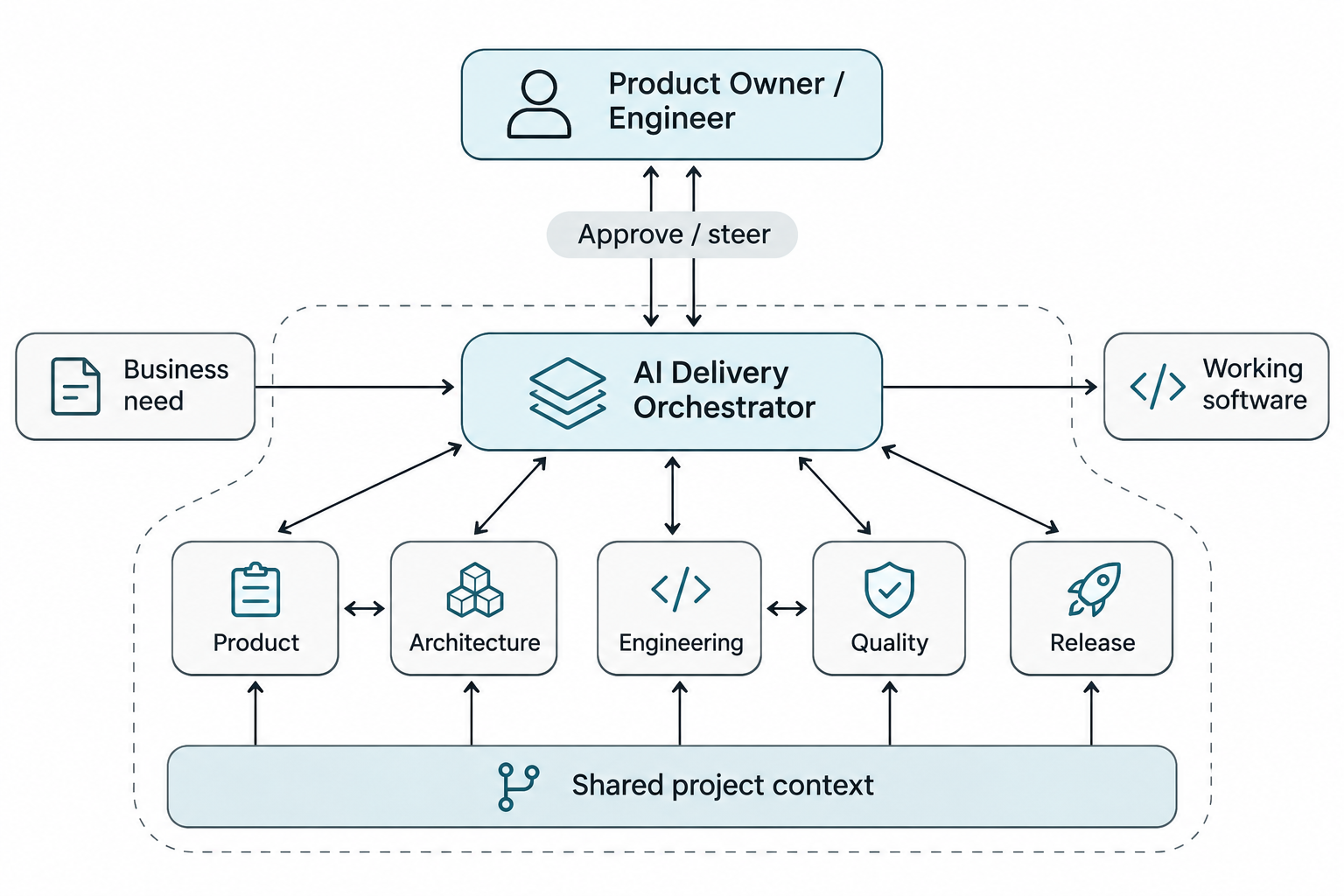 What is possible by teams of individuals is now pretty possible by one guy who knows what he's doing. (I'd love to say I drew this image myself)
I'm yet to see one of these things build Facebook, or turn Grand Theft Auto VII into something that could be built by leaving a terminal window open overnight. These things are quite common now, though, and the proof that the concept has legs will be in whether we see one rise to lead the market. I have to wonder why we're not seeing a huge drive toward this from some of the big players; certainly Microsoft, who have already pocketed GitHub and have stuff like Azure DevOps and MS Office behind them already. Or maybe it has, and I've just not spotted something right in front of me (a quick bit of research shows that at least AWS are at it).
Industry inversion
One way or another, a few things are happening in the world of web software consulting, and happening quickly.
1. AI makes procurement much easier for the supplier and much harder for the buyer
If there is any software house bidding for work that is still putting proposals together by hand (or, let's be honest, it's mainly repeated patchworks of bits of previous bids), they need their collective heads checking. Whilst it still takes a pretty long time to put together competitive and realistic plans for delivery of a significant round of software dev, it takes merely minutes to vibe-slop something that at first glance looks at least halfway sensible.
Multi-stage, extremely structured procurement phases are now the norm all the way down to noddy brochureware apps, presumably in order to assist hapless buyer staff in filtering out the volumes of slop they need to wade through. This creates a rather paradoxical situation where the increased use of AI to speed bids up actually results in a slowdown of the process as a whole.
2. Costs are dropping
This is potentially the area with the biggest knock-on impacts. A race to the bottom is underway in competitive tendering - at least when it comes to small-to-medium scale deliveries - with small operations promising to 'just AI it' now becoming able to not only massively undercut everyone else, but also go and actually deliver on the damn stuff as well. Therefore, what is likely to happen is that the 'build' part of overall delivery costs - previously something that would be the bulk of the work and manpower - shrinks as a proportion of the whole.
The focus starts to hinge more on the more 'auxiliary' elements of development, in the shape of the early-stage analysis and proof-of-concept stages making use of AI themselves to beef up their offering. It's about iterating ideas extremely quickly - typing concepts into a prompt in the meeting and turning the laptop round to say "Something like this?". Saying "We'll workshop some ideas and then send a design back to you in a few weeks" is now a non-starter.
With both costs and time-to-completion on a downward slope, it becomes easy to reason that a straightforward pivot would be toward small-scale, cheap deliveries, but at a much higher volume. For many (most) software houses, this is a false economy, unfortunately. Leave aside the fact that the industry just isn't set up for this sort of regimented, production-line style of delivery yet (more on that in a moment), take what I said in point 1 above. Picking up work isn't any easier; you need to scale up business development disproportionately.
3. 'Standard' Agile development seems finished
I always felt that Scrum was a bit of an annoying cult, but one that you just had to get on with as it wasn't really that bad, if you had a team that was willing to be disciplined. Alas, all the years of study, all those CSM courses, all that bowing and scraping to the terminology and 'believe in the process' mentality from overpaid Scrum Masters seems to have been worth little in the end.
It's pretty sad if you think about it. Software development, as a practice, spent so much time and effort in the 90s and 00s trying to clean up its act and finally be taken seriously as 'real engineering'. The solution presented to us was Agile, and we had little choice but to swallow it. The philosophy was about instilling confidence by adding checks, balances, process and structure to an industry of cowboys that were yet to shake off the habits from the 'bloke tinkering in his garage' era of hobbyist programming. In the 2010s, we got there. In a matter of months in 2025-26, it has all been binned. Product backlogs have become cemeteries of bygone productivity. Test environments are being deleted to just 'test on live'. PR policies are bypassed. All must be sacrificed at the altar of rapid AI-driven development.
I get it, too. 'Old fashioned Scrum' is simply too slow for this new world. Two-week sprints are finished. Needing two different people to approve a deployment is simply too damn slow. We need something else. That's not to say I embrace this 'vibe it and hang the consequences' emergent culture, either. We need something that provides the engineering structure offered by agile, but able to move at the much faster pace this new technology enables (and requires).
4. Being a developer gets a bit boring
AI can draw up the architecture, decide on the technology, and draw up a 50-page delivery plan, but right now you still need some sort of architect to stand there and describe the solution to the customer. The developer, meanwhile, starts to only really get their hands dirty on bits and pieces that involve too many moving parts for an agent (for now, at least). It feels like a shift toward something more like managed servicing. It really does feel grim.
Reviewing my old predictions
I mused on a few things in October 25. I wasn't about to put my house on anything, but I was pretty sure that AI was here to stay and that more than a few people were in more than a bit in denial. Let's have a look:
| Prediction | Reality |
|---|---|
| The AI 'bubble' will 'burst', and costs to use it will rise, being more business rather than consumer focused | No burst yet, or in sight. That being said, all the figures point to the fact that AI companies continue to make dramatic losses on token usage. Despite this, AI company valuations are up into the trillions of dollars. The whole thing is quite plainly a bet on the future. |
| Senior devs to spend more of their time ‘shepherding’ AI agents. | True, and not just senior devs. Prompting AIs across several different build cases at once is the job, now. |
| A pivot by junior devs new to the game toward using these tools and getting the most out of them right from the very beginning. | ...Probably. The problem right now is that hiring for developers full stop is bleak across the board. Some of this is simply down to the economy generally. I still believe that there is light at the end of the tunnel for junior developers, though; it's just different colour light and the tunnel is heading somewhere a bit unexpected. |
| A drop in software quality in general, but not a cataclysm. | There have been plenty of 'hacks' and critical software vulnerabilities exposed in things like PHP recently, but I don't think that's an indicator of a drop in software quality; rather just another scary look into what AI can do for bad as well as good. I've relaxed on this prediction - I actually think that most of the 'AI code is poor quality and full of mistakes' stuff is becoming a bit of a cope for developers in denial. The code is, almost entirely, fine. |
| 'Coasting' mid-level developers who don't tool up on AI are finished | They remain finished, and earlier than I thought. |
| With productivity increasing, costs for software delivery are likely to go down | Yes. |
| What a software contractor industry of the future might look like is small groups of greybeards building software at a similar volume to a 50-developer business today | We're not there yet, but I'm yet to see anything that walks me away from this hypothesis. The big giga-corp consultancies like Capita (and maybe even the likes of Tata) will find a way through. But for any businesses caught in the gap between Deloitte and a 10-man microbusiness, it feels like there is a struggle ahead to rediscover what it is they actually do in this new world. |
That last point I think is quite important. There will always be gigantic 250-million pound NHS contracts to feed the Capita beast. For smaller businesses, with development costs plummeting, software licence overheads rising, and supply of developers outstripping demand for development, where does that leave the business model? Pour one out for all the non-development staff like designers and copywriters who have already disappeared into the ether.
In summary
A year ago, Copilot broke my media server. Today, I might not have even realised I had a media server at all. Tomorrow, 'media server' might not be a term that 'IT professionals' ever need to learn, much like developers in the fifteen-or-so-year gap before AI may never have understood what was meant by something like 'malloc'. Maybe 'IT professional' comes to mean someone who is skilled in configuring and deploying agents to do the IT. Whichever way you slice it, it's a bloody weird time to be in web software.