Playing every PS1 game - Block Buster, Blockids, Blood Lines, Blood Omen
The first of the Legacy of Kain games.
Block Buster
The PlayStation was a testing ground for many could-be-big ideas and novel approaches to the medium, and one of the threads that weaved its way through the system’s timeline was the remaking of classic, simple arcade games from decades earlier into this brave new world of 3D, two megabytes of RAM and masses of storage space. Pac-Man got a pretty decent 3D platformer remake in Pac-Man World; Asteroids and Space Invaders got some ropey re-imaginings, and here is Breakout.
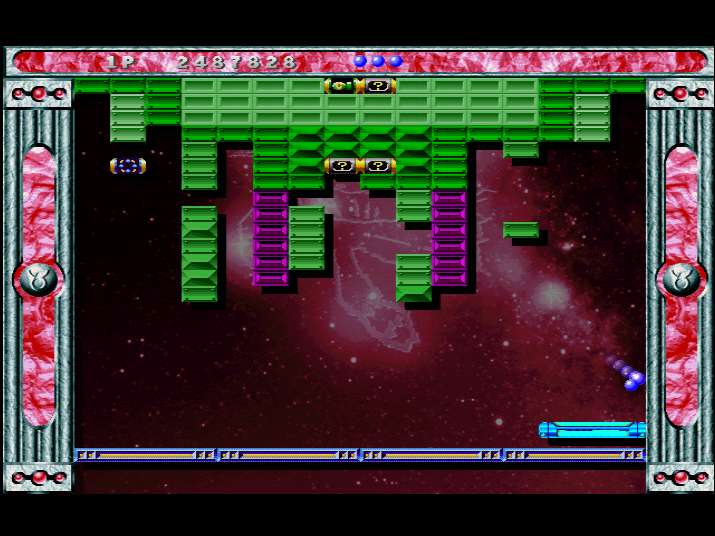 Breakout, as you’ve never not seen it before.
But wait! This isn’t a 3D remake! This doesn’t try to worm a narrative or real-world context into the game of moving green dot to green dot! What gives?
Well, Block Buster is actually just a lightly tidied up and somewhat evolved Breakout. Aside from a few bells and whistles, it’s much the same game that was popular in the 70s. And to be honest, fair play to them for not meddling with the formula; Block Buster can still be pretty fun.
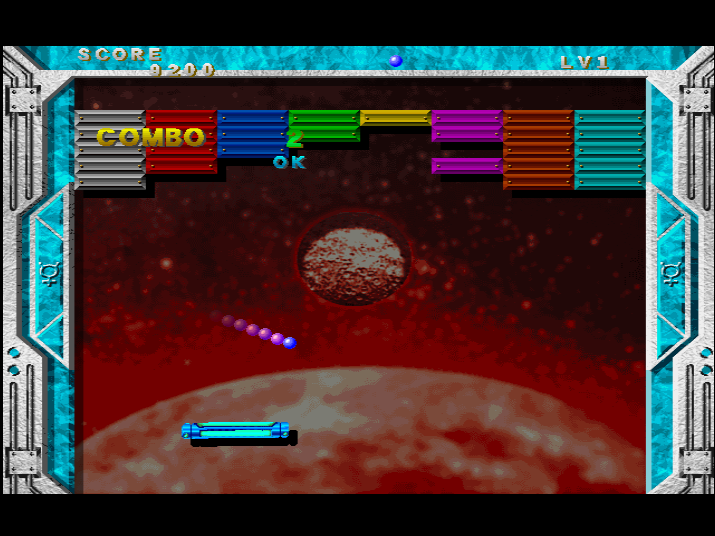 The backgrounds are rather random.
From what I can tell, the game isn’t actually affiliated with the Atari and the original Breakout, and is actually what one might call a clone rather than a remake. As a matter of fact, it was published by Phoenix Games, the slop-merchants who produced the All Star monstrosities. You can sort of tell from the Miniclip.com flash game aesthetic that runs deeply through it.
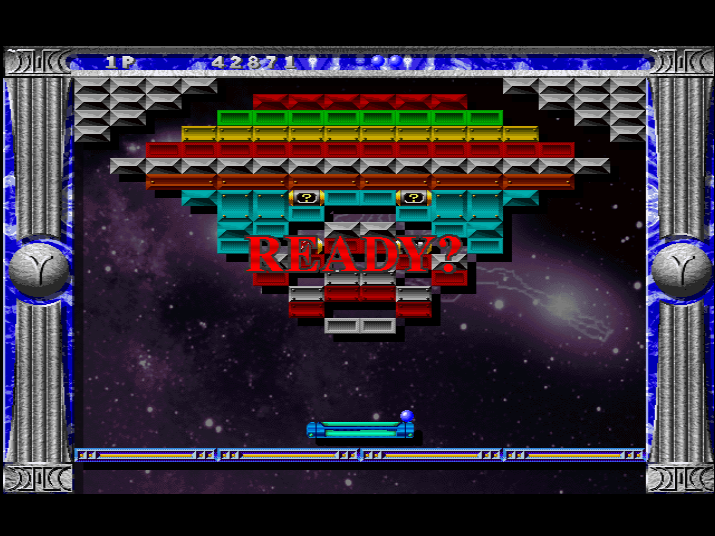 It’s Newgrounds.com years before it was a thing (and you pay for it, too).
There are a few things which mix it up a bit beyond the classic Breakout - you can angle the paddle, time your bounces with a button press to add ‘spin’ and make the ball arc around corners, and there is apparently some sort of boost that I wasn’t able to work out. You can play the classic ‘endless’ format, or a set of fixed stages with pretty block patterns to burst through.
It’s entertaining, for a while. But at the end of the day, it’s still just a very, very simple game from the 1970s.
Kept my attention for: An hour
Did I finish it?: No
Overall: 5/10
Blockids
Remember what I just said about ‘not meddling with the formula’? Well, here’s Blockids. It’s Breakout again, but this time in full 3D, and with an anime character backdrop that makes very little sense and seems to serve no gameplay or narrative purpose.
In this game, you can choose ‘adventure’ mode, select an anime character with whom you wish to embark on said adventure, then immediately forget about all that, because it’s not actually relevant to the game.
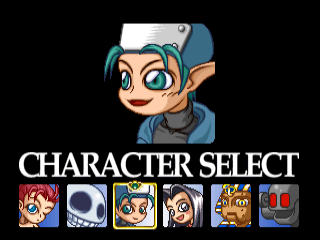 The horror…
Instead, similarly to Block Buster’s challenge mode, you play through a series of pre-defined Breakout patterns while your selected anime character makes faces in the periphery. What makes Blockids a bit different is the ability to make your ball ‘jump’ with the X button, which is about as obvious an evolution of the game of Breakout into three dimensions as you could get.
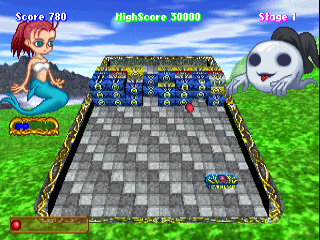 They try and turn it into a ‘battle’. But Breakout is a solo game, so it just doesn’t make sense.
What it tends to mean in practice is that you ‘jump’ your ball right to the back, early on in the stage, then just sit there and read a book whilst the ball pings around the segments, racking up a large combo and eventually dropping down a while later. What’s fun about that?
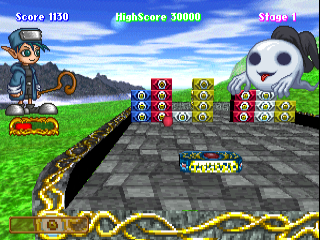 Take advantage of the 3D environment by moving the camera to useless vantage points for no reason.
It’s interesting to consider how a game that does so much more with the technology than Block Buster ends up being a worse game. Maybe as a kid you’d enjoy the anime character animations and look past the fact that the gameplay itself is inferior.
Kept my attention for: An hour
Did I finish it?: No
Overall: 3/10
Blood Lines
How to define Blood Lines? It’s a bit like Smash Bros in three dimensions, except if you swapped out the combat bit for a game of ‘tag’. Terrible comparison, sorry.
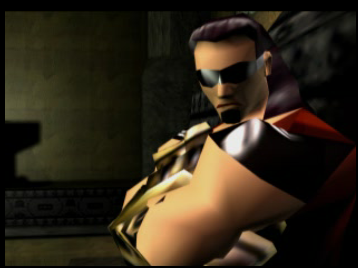 Soul patches were never cool, despite what you thought when you were 19.
In yet another game set in a dystopian, dark, industrial future, Blood Lines involves a ritualistic battle arena competition where rival clans compete for prestige in a world where little hope is left. If that sounds familiar, it’s because this concept was probably the most overdone sci-fi setting there was in the 80s and 90s.
 All the arenas are more or less the same.
The way the game works is by trying control a handful of capture points around a given arena (the arenas in question all look pretty similar) by touching them and turning them to your colour. Once you control a certain number, you win the round. Only one competitor at a time is able to be ‘it’, and tag capture points, and that is where the combat element comes in.
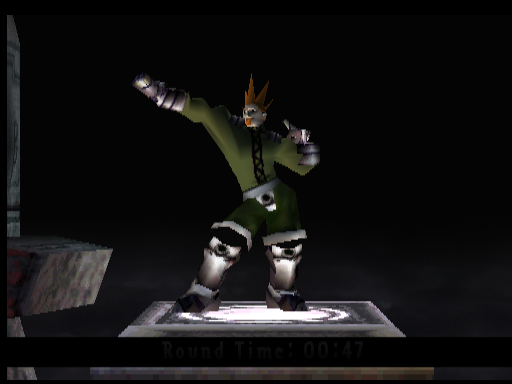 Winners get to strike a pose.
What this means is that the gameplay is either chasing around the person who is ‘it’ and trying to press square at the right time that the hitboxes cross in order to trigger a ‘beat up’ animation and gain control yourself, or be the one running away from everyone else and trying to tag capture points. You can pick up various powerups that give you a speed boost or let you shoot fireballs or whatever, but they’re not really that impactful.
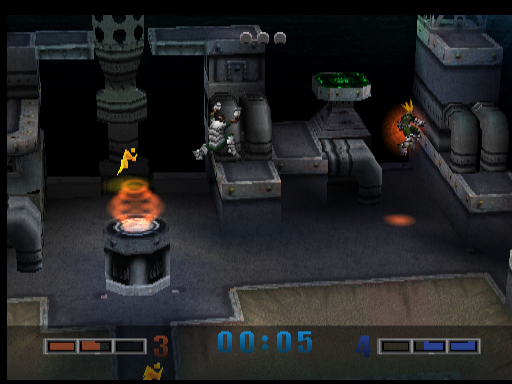 Given you can only get tagged through contact, the game encourages cheesing it by bunny hopping around.
The combat is underbaked and would have been improved if there was more distinction between characters in terms of moves and capabilities (a la Smash Bros), but as it is they’re all a bit samey. What ends up happening is running around hammering the X button to hop (so you can avoid getting tagged) and trying not to get stuck on the geometry. Providing alternative ways to win by beating up your opponent would have been another improvement.
It’s an OK game, though.
Kept my attention for: An hour
Did I finish it?: No
Overall: 5/10
Blood Omen: Legacy of Kain
The Legacy of Kain series is one I passed over as a lad but have been interested in playing as an adult for a while. Which I guess, based on the tone and subject matter, might have been the point. I have Blood Omen 2 waiting, uninstalled, on Steam (along with the other 30 or so purchased-but-never-played games making a berth on that particular list), but always had in the back of my mind that I’d prefer to play its predecessor first, either the Windows release or for PS1.
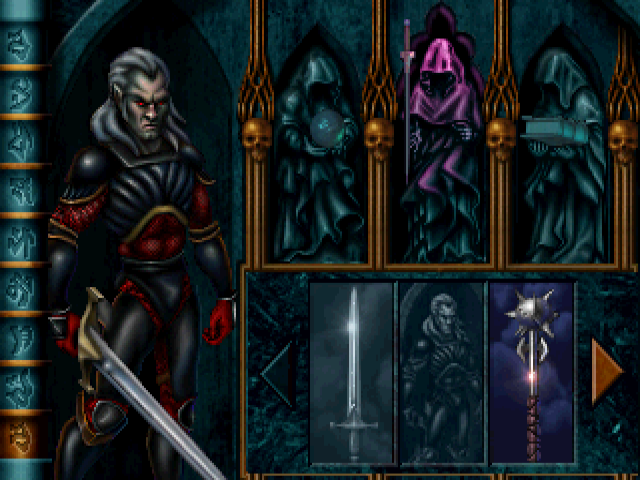 Choose a weapon, armour, spells and items and then kill everything.
For the uninitiated, Legacy of Kain (mainly) follows the story of the titular Kain, a human noble murdered and brought back to ‘life’ as a vampire in order to wreak vengeance on the inhabitants of Nosgoth forever more. This, the first in the series, is best described as a gothic-horror vampire Legend of Zelda, which despite sounding ridiculous, actually works as a concept if you put some thought to it. It’s quite slow-paced (for reasons we’ll get into), and the game picks things up shortly before Kain gets ganked and is given the chance to go back to the material plane by a necromancer called Morbius, as long as he promises to perform a few tasks along the way which may or may not involve defeating 9 unholy guardians of Nosgoth and potentially bringing peace and balance to the realm, but not actually really.
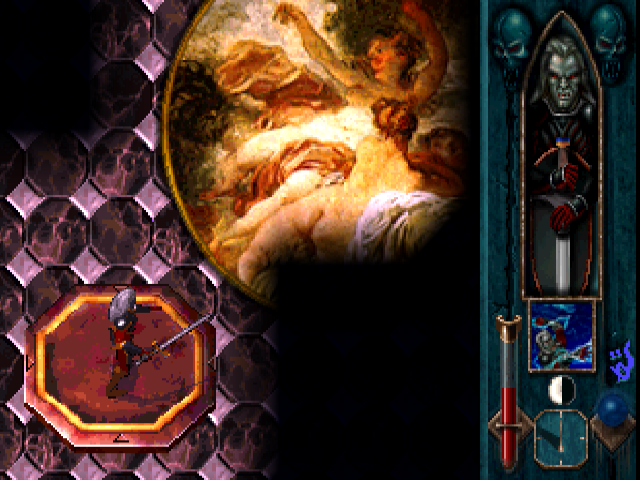 The graphics are both incredible and well past their sell-by date..
When loading up Blood Omen in 2025, it doesn’t take long for you to start wishing you’d have played the Windows version instead. It really isn’t set up for the hardware. It’s slow and lumbering. Few games require a loading popup just to pause the game, or change your equipped spell, but in Blood Omen this would be listing but a fraction of the slowdown events.
 This is actually a good 25% of the game.
It simply can’t cope. Move to a new screen? Wait. Spoken dialogue moment? Wait before and after the compressed sound clip plays. Change to werewolf form? Wait as the ‘choose your form’ spinner loads, wait as the UI responds to your input, wait as the ‘change form’ animation loads, wait as the animation completes and the game gets going again. It would have been tedious even in 1996.
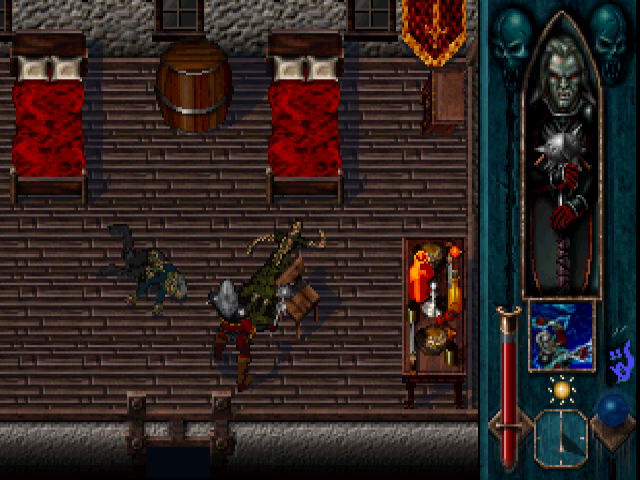 These poor saps died of plague. Don’t drink their blood.
Luckily, the game itself is very good, even if it does get a bit too difficult later on. There are plenty of interesting mechanics that all weave into each other to create lots of options with which to approach any particular situation.
Your ‘health’ bar is constantly draining, and can only be topped up by killing and drinking the blood of human enemies. Some of these are civilians, just going about their business around town. The game’s equivalent of a ‘health pack’ is a whimpering human chained to a wall, pleading for aid with which you won’t be forthcoming - there is not even a mechanism for helping them. This concept of actually playing as an out-and-out villain whose only concern is himself was a novel concept at the time, and is still something you rarely see given how difficult it is to get right. Blood Omen gets it spot on, though.
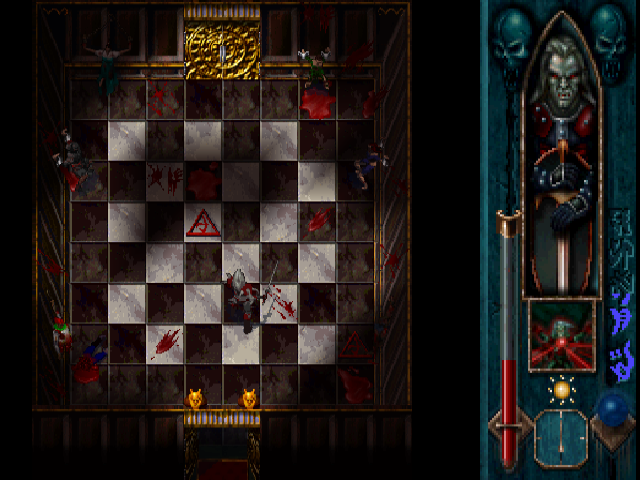 Tap a shoulder button to zoom out, and listen to your PlayStation silently scream as the frame rate plummets to a spluttering chug.
The different ways with which to take on a particular dungeon or enemy create a lot of replay value (if you can get over how much of a chore the game can be to play from a mechanical standpoint). You can fight with your sword, and use your free hand to cast spells - ranging from firing magic projectiles to making everyone on screen explode violently. Alternatively, hold axes in both hands and turn enemies to mincemeat in a spinning whirlwind attack. Alternatively, use consumable items to chop enemies up or hoover up all their blood. Alternatively, use a spell to make yourself invulnerable and eat the damage while you hack away. Alternatively, change to your werewolf form and just run past everything to the exit. Get the idea?
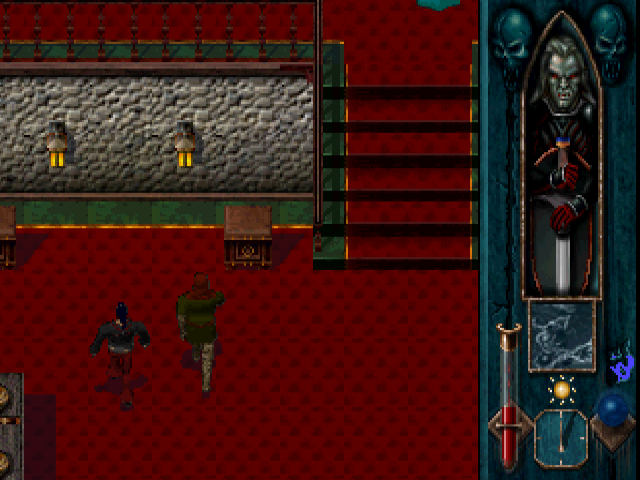 Don a peasant disguise and nobody calls the guards on you.
The script and dialogue is without doubt the best you will find on the PlayStation, and I say that knowing I have still yet to work through the letter B. The Shakespeare-writes-horror tone manages to be both morbidly descriptive, unsettling and funny at the same time. It’s worth playing just to listen to it. That aside, the plot is quite difficult to follow and really could do with some way of keeping track of who is who and what is going on. In true retro game fashion, it probably did a lot of this expositional heavy lifting in the manual. I was determined to complete it, despite how hard things were getting, but ended up putting the game aside, as I’ve been building myself a new PC recently and as these things tend to go I’ve lost the drive to continue with the game. I’ll probably go back one day.
Kept my attention for: A week
Did I finish it?: No
Overall: 7/10