Playing every PS1 game - Bottom of the 9th '99, Brave Fencer Musashi, Break Point, Breakout
In which I discover a baseball game that isn't actually that bad.
Bottom of the 9th ‘99
I do have a bit of previous with taking baseball games at least halfway seriously - I spent a week or two playing MLB The Show 19 when it was being flung for free at PSN subscribers, probably during the Covid lockdowns. I had a decent amount of fun with it, despite never really getting a full grasp of some of the more precise particulars of the rulebook (or some of the major particulars, in honesty).
My experience with PlayStation yankeeball titles has been tepid. So far, there has been 3D Baseball, which was little more than a tech demo for early 3D sport game capabilities; and Bases Loaded ‘96, which was about as nondescript a sports sim as you will see. So expectations were low.
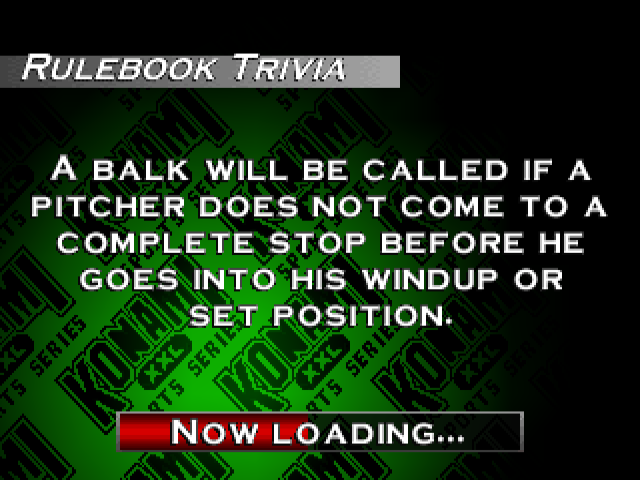 Random obscure rule trivia on loading screens is the sort of thing I live for.
And as I often find with lowering my expectations (something I do every SCFC season), I had a pleasant surprise discovering that Bottom of the 9th is actually OK, and goes much further than the previously listed twosome in providing a simulation of the game of baseball.
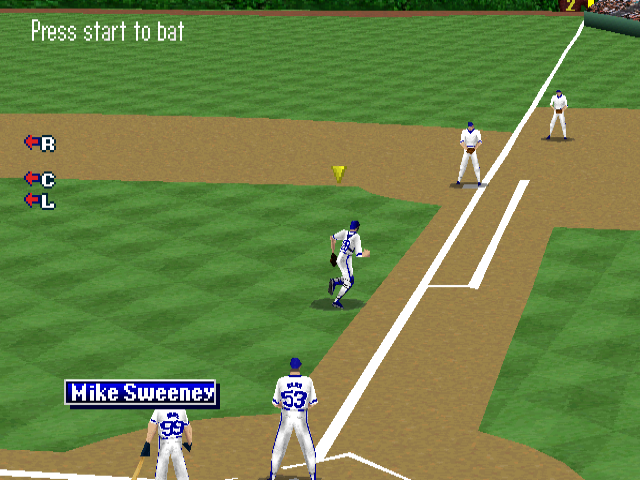 Unable to work out how to switch player, I found myself running around on the field as the wicketkeeper guy.
Where other games would tend to offer the player the chance to ‘tap X to hit’ with the only varying factor being your timing in tapping X, or ‘tap X to pitch’, where the ‘game’ is nothing more than just pressing X and watching, BOT9 actually does ask the player to think about baseball a bit and use a few more buttons than the one with an X on it. It uses a moveable catcher’s mitt to allow the player to choose a general direction of ball travel, and then pre-load a directional button combination to select a type of delivery, be it fastball, curveball, googly, doosra or whatever. I’m going to continue to use cricket terminology here, because God knows what half of the real baseball nomenclature is.
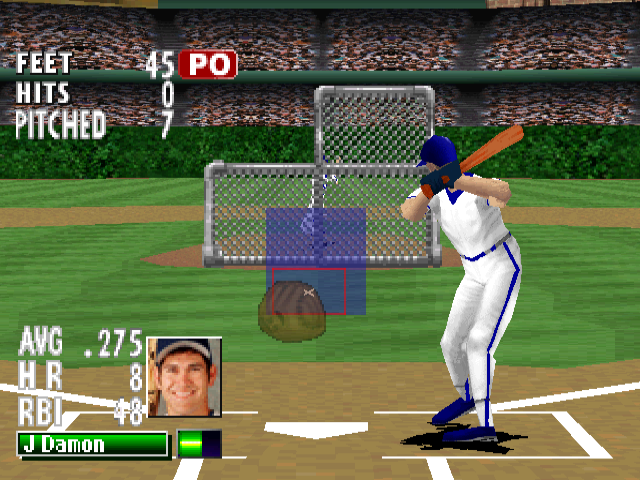 The protective fence in practice mode was certainly not required with me at bat.
That on its own wouldn’t be pushing any boundaries of simulation, however. What makes it interesting is that each pitcher has his own personal capabilities when it comes to variations, and some will come off better than others. Quite often when inputting a pitch instruction (from the behind-the-batsman perspective of the wicketkeeper), the pitcher will literally just shake his head at you, with a why-am-I-playing-with-this-idiot aura, and wait for another order. Whether it means you can really ‘set up’ the CPU player with some unexpected variations remains to be worked out, but it does create an interesting situation where pitching might actually be more fun than batting, which is still a problem yet to be solved for cricket games.
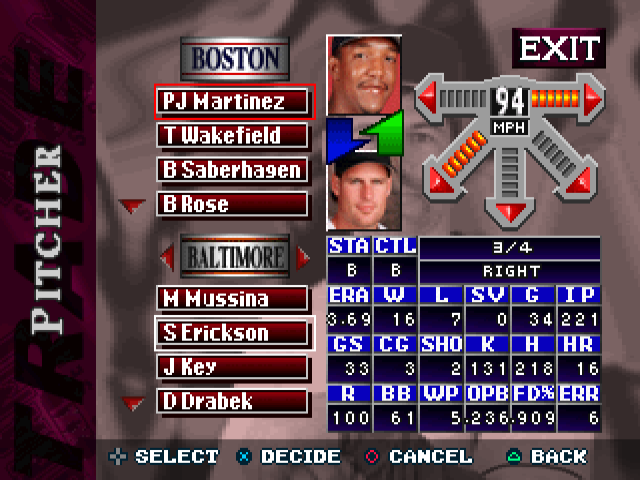 The ‘power bars’ mean this guy excels at two types of pitch, but don’t bother with any others.
I figured all this out in the rather quaint practice mode, which sets you up with all the training gear at a practice ground (though it still has the ‘full house’ crowd textures), lets you set up what type of shot or pitch you want to practice, and then leaves you to it. Fielding is pretty dull, with most of it being spent jankily trying to work out which fielder to chase the ball with, and then missing the pickup - it would be easier to just let that side of the game be handled by the CPU really.
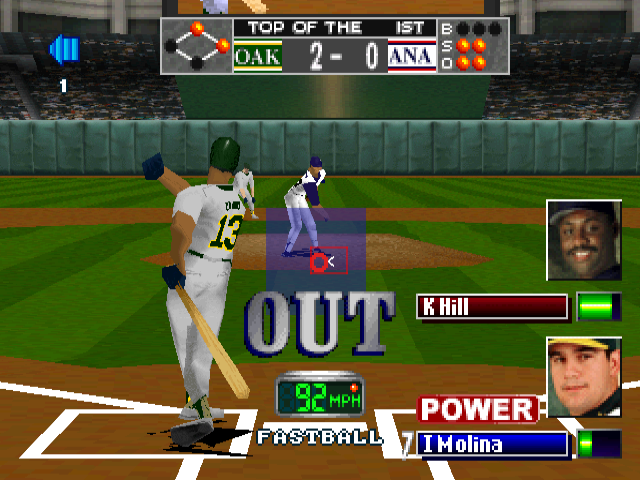 There’s a learning curve but it’s not that bad.
There are plenty of game options, including a ‘transfer’ menu letting you move players between teams, in a sporting display of player control over the roster that you wouldn’t get these days - the publishers would far rather you just buy the next iteration of the game if you wanted up to date teams. It’s nothing special on the whole, but as baseball games go this is probably going to end up being one of the better ones.
Kept my attention for: An hour or two
Did I finish it?: Yes
Overall: 5/10
Brave Fencer Musashi
Brave Fencer Musashi is one of those games which received a new lease of life in the YouTube era thanks to ‘hidden gem’ influencer types cooking up ‘retro’ content for Gen Z. I don’t remember it getting much contemporary hype, if there was any at all.
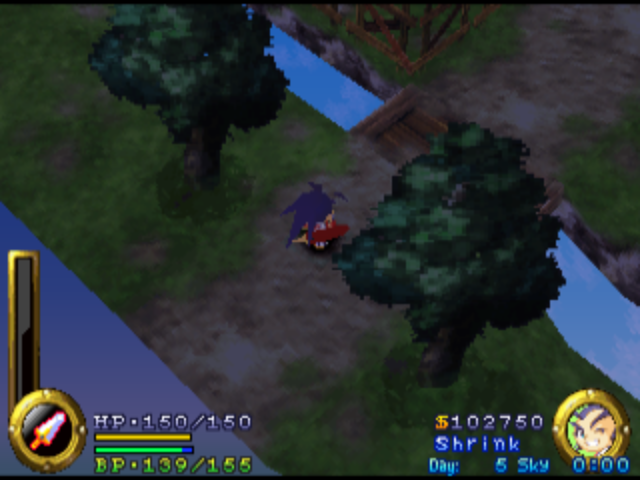 It uses the ‘3D environment floating in space’ stage setup, and I quite like it.
It’s a fairly interesting spin on the then-fledgling 3D action-RPG genre, with all the usual trimmings you’d expect from a Japanese high-ish production value localisation - ropey voice acting, weird translations, complex core gameplay systems and that vague I-hope-nobody-is-watching-me-play-this-game latent cringiness. Much like Alundra 2, it has that Saturday morning cartoon series feel to it. I don’t think that really assists the quality very much.
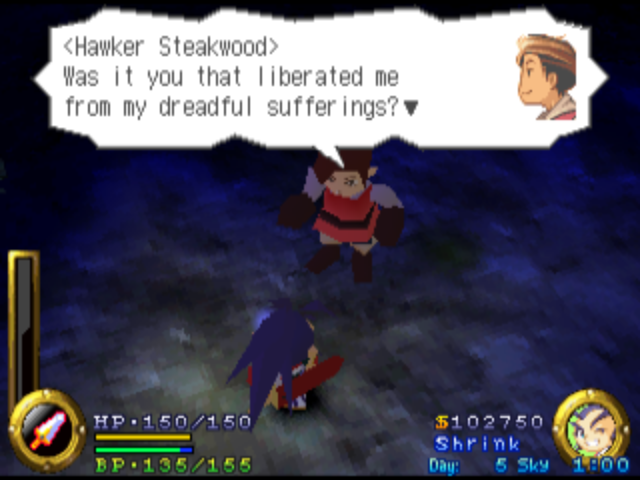 Anyone with the name ‘Steakwood’ deserves suffering.
You run around 3D stages, hammering square to swing your sword and constantly pressing the shoulder buttons to awkwardly rotate the camera in fixed increments. There’s a semi-familiar ‘build up the village’ element, where the main objective is to rescue missing townspeople from the surrounding forests and dungeons, frequently returning to a hub village area to rest, upgrade and check in on various plot developments. Nothing particularly novel there, but the cool bit is the fact that there is a full day-night cycle, with townspeople having their own routines and the player needing to time their stays at the inn and trips out into the jungle in order to not find themselves hanging around a lot.
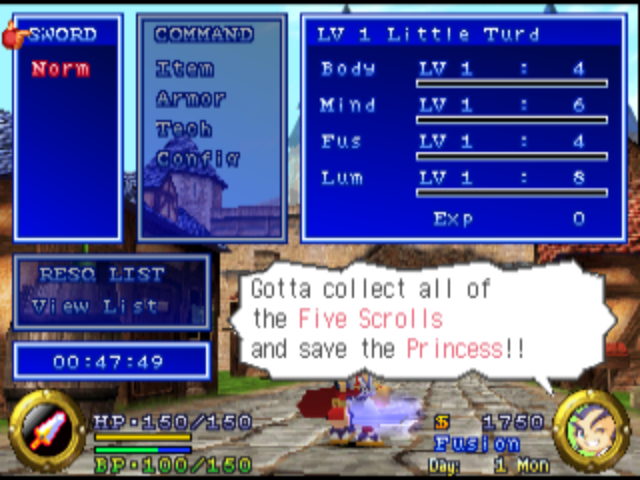 Wake up babe, brand new RPG plot concept just dropped.
New players are led to believe based on the kid-friendly (and long) introductory scenes that this will be a untaxing game designed for kids and early teenagers. It’s definitely the latter, but this game is actually pretty damn hard. The first ‘level’, which more or less serves as an elongated tutorial sequence, ends in a boss battle that is truly quite difficult and took me by surprise. Once you’re out there in the guts of the game, you are frequently swarmed by enemies, and your health bar starts to look disconcertingly lean. It’s also quite difficult to work out what to actually do sometimes, as orders and directions from NPCs can be quite cryptic. I quite like that, though - a change from the modern trend of lighting up not only exactly where the next quest point completes, but giving you the path toward it.
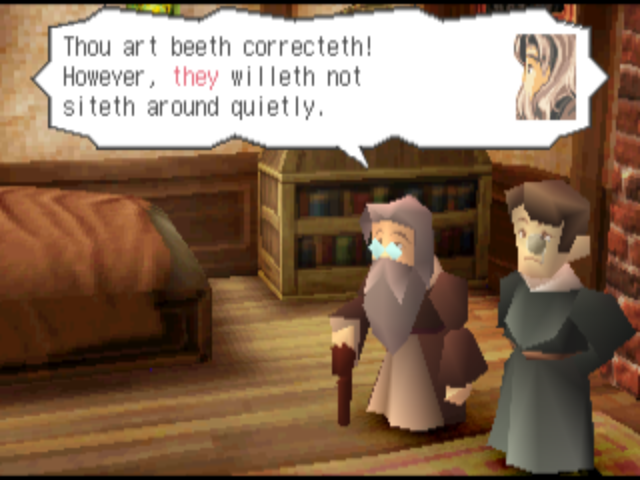 The translation tries to be ‘whacky’, but actually just comes off as a bit dumb.
Difficulty in itself isn’t necessarily a negative, and can often be a positive. Unfortunately for Brave Fencer Musashi, too much of the difficulty is down to shabby controls and bad hitboxes. With no lock-on system, orienting yourself in order to properly hit an enemy can be a lottery, and you will swish at thin air a lot (then get hit yourself because you accidentally touched the hitbox after your swish animation finished). A lot of the game revolves around ‘absorbing’ enemy skills in order to use them yourself, which is actually a great idea, but pulling it off is just a pain in the arse and relies too much on the luck of not taking a hit while you stay still in the absorbtion process (which will cancel it).
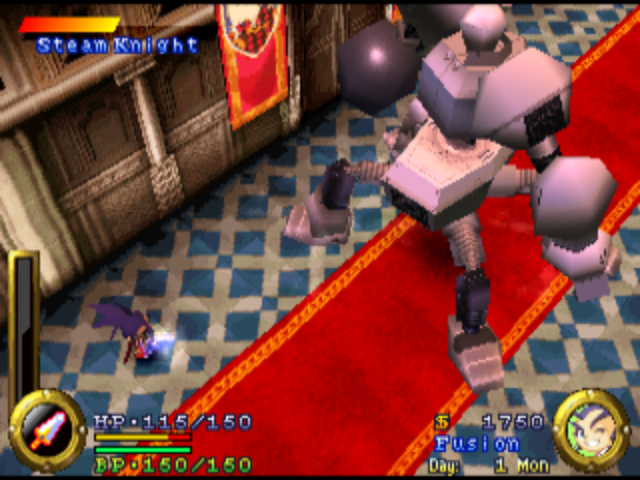 I reckon few players beat this opening boss.
I went into the game with the express intent of finishing it, but I actually got pathetically far. Yes, you can say I got ‘filtered’, but I didn’t quit because I was finding it ‘too hard’ (though I was finding it hard), I just got a bit fed up of it. Sometimes when this happens, I wonder if I’d have enjoyed it better as a lad; here, I don’t think I would have managed to get past the first boss level and would have only ended up playing it a handful of times. Just not my jam, I suppose.
Kept my attention for: A few days
Did I finish it?: No
Overall: 6/10
Break Point
Here’s the truth - I have already played the best tennis game on PlayStation. It’s Anna Kournikova’s Smash Court Tennis. All other tennis games need to be considered in comparison with it. I didn’t even think Smash Court Tennis was anything amazing, but I think it’s unlikely any others come near it.
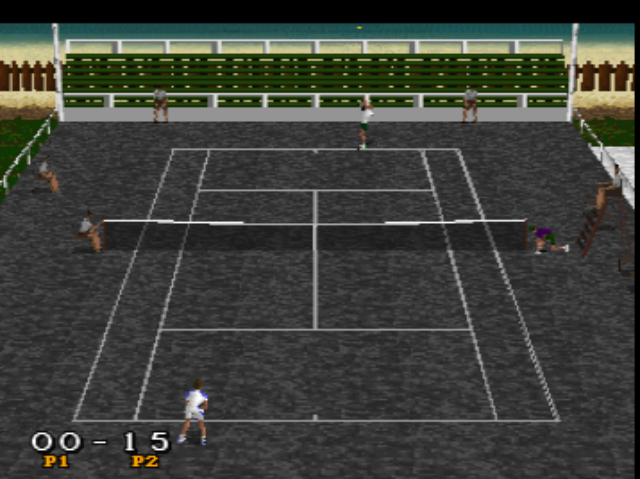 Serving is stupidly hard for the newcomer. You have to time it perfectly, or the ball drops to the floor and you waft at the air like an imbecile.
I’ve played Break Point before; as a matter of fact it was one of two random game discs (without boxes) that came into my possession through means I don’t remember back in 2000 or so - the other was actually Batman & Robin. I only really played it a handful of times, as I wasn’t big into tennis and neither did I find Break Point particularly gripping.
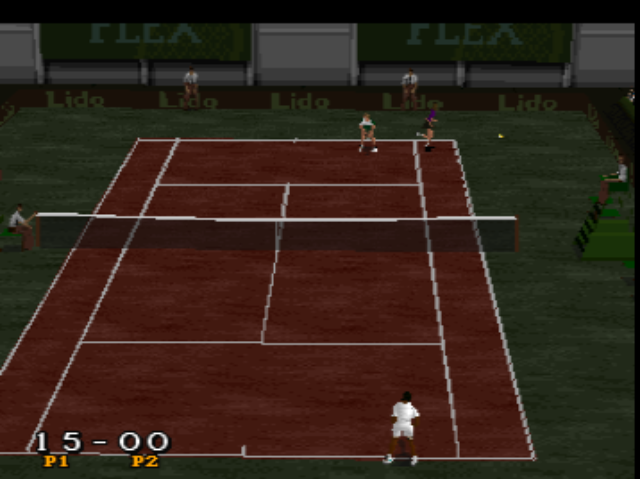 Environments have a certain charm to them but are pretty dull.
While Smash Court Tennis was about arcade action and All Star Tennis ‘99 was about playing tennis with bombs, Break Point takes an altogether more relaxed, cerebral approach.
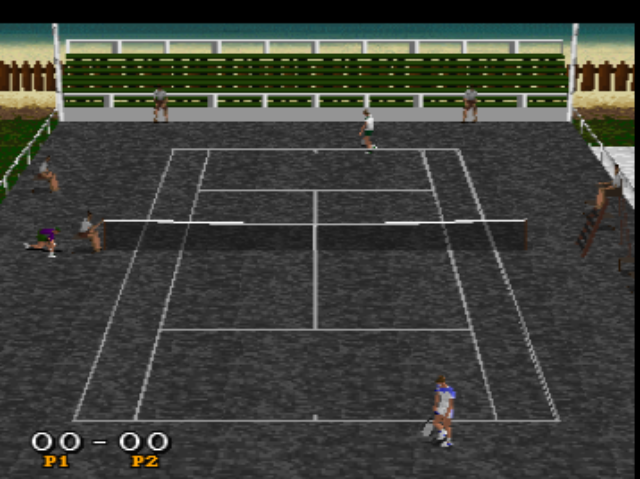 Everyone in the game just looks depressed.
A bit too relaxed. The pace at which Break Point is played is lethargic to the point that the game is almost in a figurative coma. The main menu has a electonic musak backdrop (along with its two game options - play a one-off game or a tournament), in-game the players sedately slope into positions with the verve of a man walking to the gallows, even the ball seems to float rather than move across the court with any sort of pace.
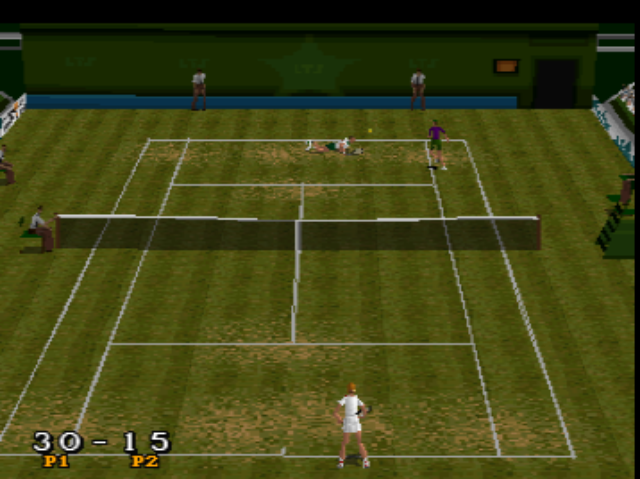 This is the only venue in which you play where it appears anyone is even in the audience watching.
The games take place in almost total silence, save for the hollow bip sounds of ball on court (or racquet) and the calls of the indifferent, vaguely judgemental umpire. It’s almost like tennis played in a dream sequence. Much like a dream, too, there isn’t really any substance to the gameplay. It’s quite hard to get to grips with, and the way the hitboxes work mean it’s hard to tread the line between being close enough for your racquet to meet the ball and being close enough for the the ball to harmlessly thud into you and drop to the floor.
The ‘tournament’ mode seems to work as a sort of season of one-off games at the various courts available in the game, but aside from that there’s nothing much else going on in Break Point. A very strange game.
Kept my attention for: Half an hour
Did I finish it?: No
Overall: 3/10
Breakout
A while ago I talked about the move to 3D on consoles meaning ‘retro’ (as the case may be) games were getting remade but with ‘modern’ game design techniques, like a narrative and characters. Here’s a great example.
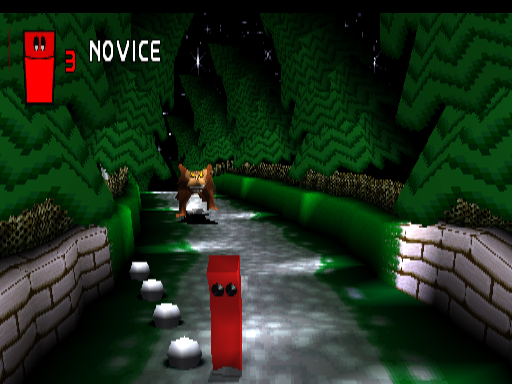 The famous part of Breakout where you, er, run toward the screen to outrun a chasing wolf.
At first glance, the assumption with Breakout is that you’re probably in for something along the lines of the old classic game, but in 3D, with maybe one or two new gimmicks. Well actually, Breakout goes totally off piste here by introducing a cast of characters - as much as a group of 3D cubes with eye textures can be considered characters - a plot, a villain, and honest to God dramatic peril. For a game that is actually just playing keepy-uppy with a marble.
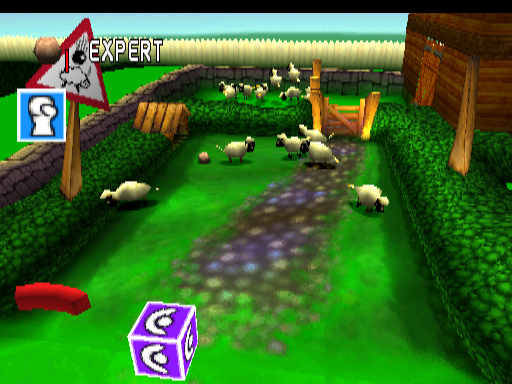 The other famous part of Breakout where you herd sheep instead of crack blocks.
It’s pretty wild. You have to appreciate the effort made to construct a narrative out of literally nothing and string a series of levels together, complete with bosses. It’s not like the plot itself is ambitious at all - it’s basically Super Mario - but it’s so daft that the whole endeavour becomes funny.
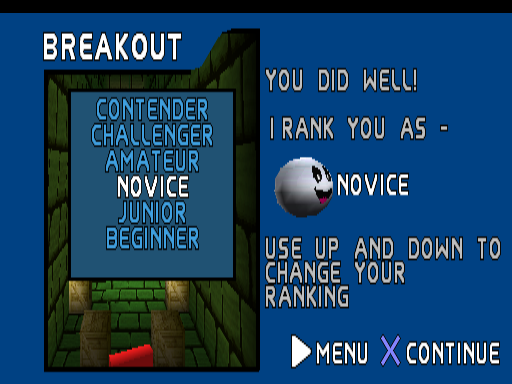 The game sets your difficulty based on performance in a tutorial. I’ll concede that is a novel idea for the time.
As for the game, it’s very much just Breakout. Why change it? The gimmicks thrown in are familiar - press the shoulder buttons to tilt your paddle or whatever - though the level design gets a bit whacky, making it almost more like a pinball game than strictly Breakout. It being what it is, it’s not exactly going to blow any minds, but it’s OK for a bit.
Kept my attention for: An hour
Did I finish it?: No
Overall: 5/10