Playing every PS1 game - Burning Road, Bushido Blade 1 & 2, Bust-a-Groove, Bust-a-Move 2
Rounding off the letter B.
A few remaining before A and B (and 0-9) can be ticked off. In a totally pointless side remark, I’d suggest that the games beginning with A were slightly better than those beginning with B. Yeah, that’s right.
Burning Road
One has to remember that at the release of the PlayStation, computer games were still heavily (you could get away with saying mainly) associated with arcades and arcade games. There were plenty of designed-for-home-console games about, but one of the real aims for consoles with the jump to 3D was putting half-decent facsimiles of popular 3D arcade games in your home. Sega were well placed to succeed at this and had a go with the Saturn, but got it all wrong.
 2026-02-16-20-28-00.png) Square to accelerate and X to brake. These really were early days.
Square to accelerate and X to brake. These really were early days.
Sony were at a standing start, having no ‘home’ IPs like Sega Rally, and had to rely on pinching some and making others up. So we have Burning Road, which clearly aims to be the PlayStation’s answer to Daytona USA. Everything is there when you look at the Daytona arcade game, but to really see it you need to look at the Sega Saturn port. The grainy, chunky look and bright colours, the larger-than-life feel to everything, it’s got a bit of Sega Rally sprinkled in too.
 2026-02-16-20-29-13.png) It’s a Saturn game, but on the PlayStation.
It’s a Saturn game, but on the PlayStation.
The enjoyment with Burning Road burns fast and hard, then it’s over. It’s a true arcade game - that never actually reached an arcade. You slot in your figurative coin, have a bash, then step away and go and stare at the demo loop of House of the Dead, thinking all the while that slotting some zombies may have been a better use of that £1. Much like Daytona et al, there are only three tracks, and it tries to con you into thinking there’s more to them by adding a reverse of each. There are a handful of cars that differ in terms of acceleration and tyre grip.
 2026-02-16-20-36-54.png) The choice of vehicles includes a monster truck for no reason.
The choice of vehicles includes a monster truck for no reason.
It seems to be the tyre grip that’s most important, as half the battle with the game is not sliding off the track to scrape around corners via the course barrier. Even on the easiest difficulty, I found Burning Road hard. I don’t know whether I was doing something wrong, but meeting the qualification times to progress was quite a challenge.
 2026-02-16-20-44-53.png) You came 6th, but continue anyway because the placings don’t matter.
You came 6th, but continue anyway because the placings don’t matter.
It uses your overall time in a race, rather than your finishing position, as the judge of whether you progress to the next stage, and it’s obvious why - your finishing position is a total lottery. There is a truly hilarious level of rubber band AI logic in the game, meaning if you’re ahead, the slightest deviation will mean the whole pack overtakes you in a matter of moments, and even if you’re way behind, you’ll find that you magically turbo boost toward the front again before the lap is complete. You’d think this would be frustrating, but it’s actually so egregious that you have to find it funny instead and just ignore the positioning.
 2026-02-16-21-02-26.png) It will only last moments.
It will only last moments.
That’s about it really. Once you complete the third race, that’s basically all there is to experience. Ridge Racer was probably better and within a few years nobody wanted to play this sort of racer anymore.
Kept my attention for: An hour
Did I finish it?: No
Overall: 6/10
Bushido Blade
1997 was a slam dunk year for Square. Final Fantasy VII was one of the few games that you could say changed everything forever without sounding too much like a hyperbolic fool, but they also made Final Fantasy Tactics (which unfortunately eluded those of us in Europe until it was eventually available to the relatively few people who owned a PSP a decade later), SaGa Frontier, and a well-before-its-time fighting game called Bushido Blade.
 2026-02-18-21-30-49.png) There was also an obscure shooter called *Einhander*, but nobody ever talks about that one.
There was also an obscure shooter called *Einhander*, but nobody ever talks about that one.
To call Bushido Blade a ‘fighting game’ would be to do it a grand disservice. There are no health bars. There are no 10-hit combos. There are no flaming backflips and physics-defying finishing moves. There’s certainly no loudmouth announcer with a funny accent shouting “PERFECT” when you humiliate your opponent with a barrage of roundhouse kicks finished up with a Tombstone Piledriver. It’s far more…cerebral.
 2026-02-18-21-27-37.png) It looks really good.
It looks really good.
The core idea is that you’re looking to one-hit-kill your opponent - complete with 2D-sprite blood spurt - with a bladed weapon of choice (or a warhammer), and the fight isn’t over until one of you manages it. So, far more like how an actual sword fight might go down, though I have to admit my own lived experience with samurai sword single combat is a bit limited.
 2026-02-18-21-44-10.png) The ‘weapon selection’ screen is quaint. A woman hands a blade to each competitor and they respectfully bow to each other before the ultraviolence begins.
The ‘weapon selection’ screen is quaint. A woman hands a blade to each competitor and they respectfully bow to each other before the ultraviolence begins.
True to how things tended to work in the 90s, the game gives you very little in terms of player direction. There is a ‘training’ mode, but it doesn’t actually teach gormless players how to play the game; it just puts you straight into a fight like any other - except with wooden swords - and the fight just repeats until you’ve had enough. If you want to learn how to play, you need to read the manual, and even then all the manual really provides you is a primer on what the buttons do - triangle for a high attack, circle for a body attack, X for a low attack, square to (attempt to) parry, and the shoulder buttons to bring your stance to a high/medium/low sword posture. It becomes up to you to learn to watch how your opponent moves, track where his or her weapon is, and move to attack an opening, while gambling with the fact that you may leave yourself wide open to a quick death yourself if you miss.
 2026-02-17-21-39-24.png) This is the loading screen. I like it.
This is the loading screen. I like it.
The story mode carries a rather threadbare plot, even by fighting game standards. Something about a secret assassin cabal or whatever, with very short interludes between fights where your dude/dudette might utter a few anime-tier lines of vaguely coherent dialogue. The game achieves a rare feat of managing to actually finish more suddenly than it begins. You defeat the ‘final boss’ - an opponent that you WILL mistake for just the next enemy in the story mode sequence and can be defeated in a single swish of your weapon whilst he is still bowing in greeting to you if you wanted - and then you get shown a black screen with a short superimposed sentence about nothing in particular, and get sent back to the main menu. There are a few unlockable characters, but there isn’t a wealth of side content to grind through.
 2026-02-18-21-44-37.png) First-person mode is cool but not too practical.
First-person mode is cool but not too practical.
All that isn’t really relevant, though. What the developers clearly wanted to do was build a novel and interesting combat system, which they did. Everything else does feel a bit tacked on. There is a player v CPU mode, a rather strange ‘Slash’ mode where you chop down 100 enemies in succession, and a ‘POV mode’ where the game starts to enter tech demo territory. Everything was quite unique for 1997, and still is, really.
 2026-02-18-21-49-08.png) ‘Slash’ mode is a rather strange diversion.
‘Slash’ mode is a rather strange diversion.
The game is one of those that has a better reputation now than it did at the time, where it was considered a decent enough game, but the world moved on quickly. Looking back at it now, I think you can appreciate a bit better just how much they nailed the ‘feel’ of the game. It’s no coincidence that a lot of the ‘retro game nostalgia’ online content on places like Instagram and Twitter ends up being .webm loops of the lush, silent, dreamlike environments of Bushido Blade.
Kept my attention for: A couple of days
Did I finish it?: Yes
Overall: 7/10
Bushido Blade 2
Where do you go from Bushido Blade? The original was great but maybe manifested as a little too much tech demo and not quite enough game. Combat also still felt like a bit of a lottery. But isn’t that really sort of the point? Hmm.
 2026-02-20-21-25-06.png) It still looks brilliant.
It still looks brilliant.
Bushido Blade 2 from the outset comes across a bit disappointingly as if it’s making a small shift toward the mainstream. The intro video and general UI feel does tend to swing a more action oriented and quicker of pace, as opposed to the staid and sedate pace of the original. Luckily, this feeling is for the most part superficial. The combat hasn’t been tinkered with too much, and that is to the game’s credit. It’s still hard to really be sure that any hit you get in (or a block) isn’t down to dumb luck, and it can still be a bit too straightforward to just hammer the same move, but the system is still quite a fascinating one.
 2026-02-20-21-13-01.png) Occasionally you lock swords and must mash buttons. This was in the origninal too.
Occasionally you lock swords and must mash buttons. This was in the origninal too.
A couple of the weapons have gone, for reasons I’m not sure about. The story mode now at least half way makes sense and include English voice acting and some very cheesy mo-capped cutscenes in between fights. You have to face down a series of ninja redcoats before each actual opponent, which to be honest stinks of needless filler, but the game would be over lightening quick otherwise. “Slash” mode is gone, but we get a proper training mode and a ‘group battle’ mode instead, where you pick one of the game’s two factions and duke it out one-on-one until one team has no combatants left.
 2026-02-20-21-29-46.png) POV mode is back, albeit with a wire mesh view of your own appendages for some reason. Performance?
POV mode is back, albeit with a wire mesh view of your own appendages for some reason. Performance?
It’s tricky for me to say definitively which I think is a better game. BB2 is the more polished experience, and more accessible (and probably fun) to play with, but there is something about the visual design and quiet, bushido quality that permeates through every part of the original that wasn’t quite replicated in its sequel. Where is the quaint 3D woman handing your chosen weapon to your chosen character? Where is the bow before each fight (in the middle of which you can just run in and cut your opponent down and then get berated for being dishonourable)? Where is the stage with the gentle waves washing up on the beach around the ankles of two indifferent combatants? It was a bit of a lightening in a bottle moment and I don’t think anything quite like Bushido Blade has come around since.
 2026-02-20-21-25-16.png) Yes, that is in fact an M-16 rifle.
Yes, that is in fact an M-16 rifle.
Kept my attention for: A day or so
Did I finish it?: No
Overall: 7/10
Bust-a-Groove
A bit of Japan-versus-the-world naming confusion to clear up here first. Bust a Groove has no relation to the game Bust a Move, on which there’ll be more later. I always thought this might have been some sort of spin-off of Move, but in honesty I’d never thought about either very much.
 (En,Fr,De,Es,It) 2026-02-20-22-09-50.png) Yeah, it’s that sort of game.
Yeah, it’s that sort of game.
Old school rhythm action games like this are supposed to be played on a knackered old CRT television with a wired up controller rather than on a flat-screen LCD with a bluetooth joypad throwing signals through the ether. My setup is the latter, so the input lag renders games like this at best extremely punishing, and at worst - and unfortunately in the case of Bust a Groove, rendered unplayable.
 (En,Fr,De,Es,It) 2026-02-20-22-11-30.png) That is indeed a rather concerning giant milk bottle.
That is indeed a rather concerning giant milk bottle.
Bit of a shame, then, that it looks like this is actually pretty decent. It’s a classic ‘push the button combination in the right time slots which happen to line up with the beat of the tune’ format, but for each few bars it’s only really the last button in the sequence that needs to be on time. Good thing, too, as the window for getting it right is very small, in the order of a few frames. Even with a proper setup you would need to have a genuinely half decent sense of rhythm to be much good.
 (En,Fr,De,Es,It) 2026-02-20-22-03-21.png) Once again, the ‘practice’ mode doesn’t actually teach you how to play, rather lets you grind until you work things out.
Once again, the ‘practice’ mode doesn’t actually teach you how to play, rather lets you grind until you work things out.
After faffing with the practice mode for a bit and getting nowhere, I had a go with the ‘runahead’ option on the emulator, which uses savestate chicanery to make inputs effectively operate a few frames earlier than when they would have normally, and gets over the input lag. A bit. It’s tricky to get the configuration right, and ironically I’m so used to input lag being a fact of life that I have to actively try and stop making anticipatory inputs.
 (En,Fr,De,Es,It) 2026-02-20-22-18-48.png) The name’s, er, Heat.
The name’s, er, Heat.
This made things a bit easier, but I was never going to get far. The game has some half decent europop-trash tunes but seems like more of a multiplayer oriented affair than the sort of thing that would get tons of mileage alone in your bedroom.
Kept my attention for: An hour or so
Did I finish it?: No
Overall: 6/10
Bust-a-Move 2
Bust a Move? Bust a Groove? Bust a Move 2? Arcade Edition? What chaos is this?
 2026-02-21-13-21-13.png) Single player mode has you completing ‘puzzles’ against the clock.
Single player mode has you completing ‘puzzles’ against the clock.
It took me a while to work out, but Bust-a-Move is actually just the PAL and NA name for the Japanese Puzzle Bobble series, which is itself a spin-off of Bubble Bobble. The original was only availabe in arcades, and so we had to start off with the second entry. No relation with Bust a Groove whatsoever.
 2026-02-21-13-31-14.png) The strange gears-and-cogs background doesn’t mean anything.
The strange gears-and-cogs background doesn’t mean anything.
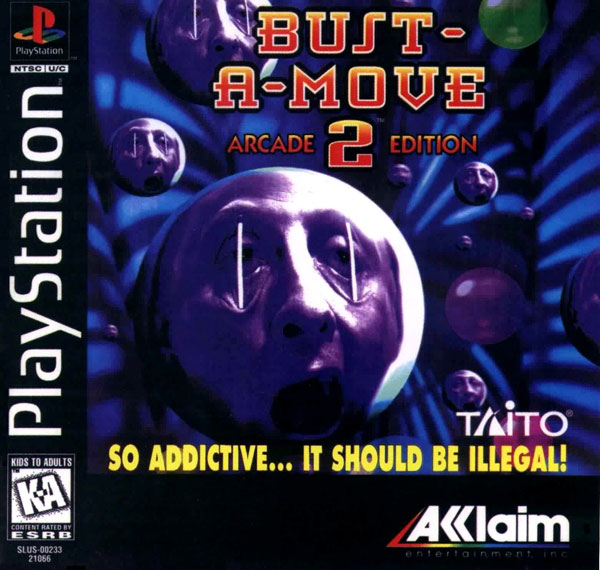
I can understand why the game was ‘rebranded’, so to speak, for western audiences - removing the toothless anime children and colourful friendly dinosaurs from the packaging in order to nick the custom of a few unsuspecting British teenagers who thought the box art looked a bit edgy (I’m serious, too. The horrifying North American box art caused a bit of a stir), but what we have here is the most complete disconnect between an outward-facing branding and the actual game that you will ever see. Once you boot the game up, the moniker “Bust-a-Move” ceases to make any sense (if it did to begin with) for a game that involves lining up multicoloured bubbles while kid-friendly sound effects swoosh in the background.
 2026-02-21-13-33-13.png) Firing off the bubbles correctly is fiddly, and a bit frustrating, but fun when it comes off.
Firing off the bubbles correctly is fiddly, and a bit frustrating, but fun when it comes off.
It’s difficult to get over how jarring the difference is. The series got almost suspiciously rave-worthy reviews at the time, but I’m not too sure why. It’s pretty clever, and I can see it being addictive in the sense that Tetris can sometimes reel you in for weeks at a time, but the annoying Cebeebies music and sickly sweet visuals must surely be a turn-off for anyone who has seen more than a dozen winters. In fact, yes. It’s like playing Baby’s First Tetris with a cheese grater grinding at your ears.
 2026-02-21-13-39-29.png) There isn’t much variety.
There isn’t much variety.
This must have been the line of thinking at the publishers when it came to localising Bust-a-Move. Con? No. Dishonest? Yes.
Kept my attention for: A few hours
Did I finish it?: No
Overall: 6/10