Playing every PS1 game - Casper, Castlevania Symphony of the Night & Chronicles, Castrol Honda Superbike Racing
In which I make a difficult Castlevania admission.
Casper
Casper is one of those 90s American-middle-class-family-films-ripe-for-merchandising that I never showed any interest watching as a child and certainly show no interest in watching as an adult. All I remember is that it was a bit of a ‘thing’ for a while and that it causes modern audiences to wince at the spectacle of some early CGI. You’d think that given the characters in question were little more than amorphous white turds with funny faces their representations could have stood the test of time, but there we are.
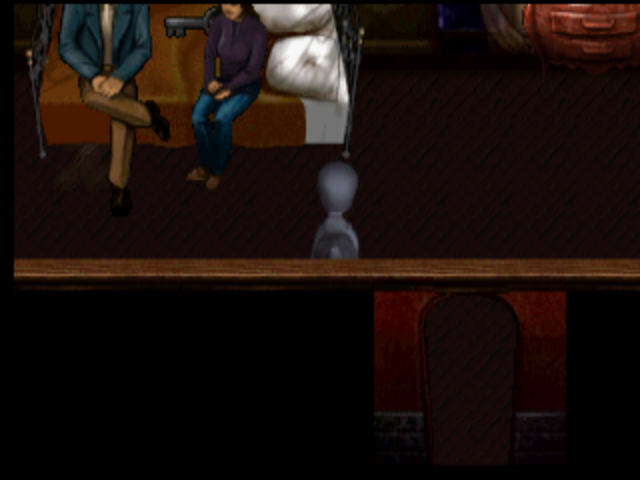 …George Stobbart!?
The Inevitable Videogame Tie-in is actually an adventure game of the point-and-click kind, but without the pointing or clicking, and instead the player is engaged in controlling the Toothpaste Kid and interacting with the environment directly. It probably loosely follows the plot of the film, but only in terms of the goodies and baddies existing in the same haunted house and there being some macguffin that must be found and operated in order for the credits to roll.
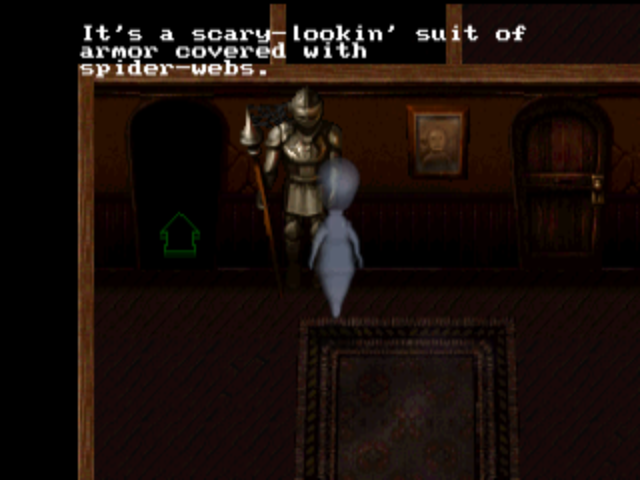 Most items in the background cough up a short description if pecked with the ‘inspect’ button.
You know what? It’s actually about OK. As anyone who has played Resident Evil knows, placing the player in a sprawling haunted house with lots of locked doors and challenging them to bit-by-bit clear the place out makes for an intuitive and diverting game. Casper does this, except without the walking corpses and giant serpentine abominations. You collect keys to unlock doors which will give you other keys to unlock other doors, which will give you special item A which you can use back at the first locked door to open Area B. Repeat.
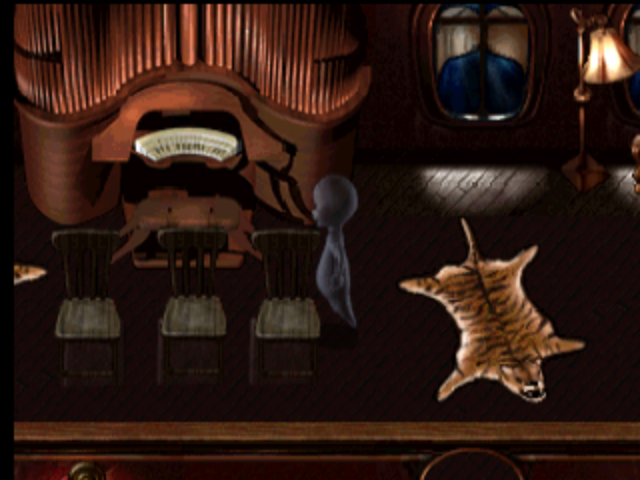 Some puzzles involve pushing bits of furniture about.
What makes Casper interesting is the complexity of the mansion layout. To begin with it is quite simple - you start in the main foyer area of the house and can go along three corridors (two downstairs and one upstairs) on each of the east and west ‘wings’. Some doors are locked, and you build a small mental map of where you have and have not been. Over time, the newly unlocked areas become more and more winding and complex and it becomes impossible to simply memorise it. The game even outright tells you in an in-game document that you should probably get a pen and paper and draw a map as you go. It sounds silly to begin with, but after a while you realise you probably should have started scribbling an hour earlier as you pad around, hopelessly lost.
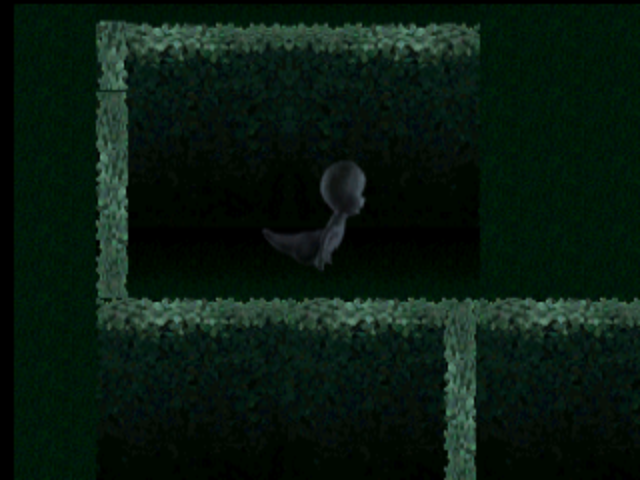 Lacking any sense of irony, outside the mansion is also a large hedge maze for you to navigate.
It’s this complexity that ends up letting it down. The place really is so damn big, and you move around so slowly, that even if you drew a perfectly labelled map, losing where you are or realising you’ve gone to the wrong end of the building ends up getting frustrating. A simple ‘return to foyer’ option would have been helpful, but without one (and without a map), getting totally lost and spending 20-30 minutes sloping around corridors and getting stuck in loops trying to make your way back to the foyer becomes a regular occurrence.
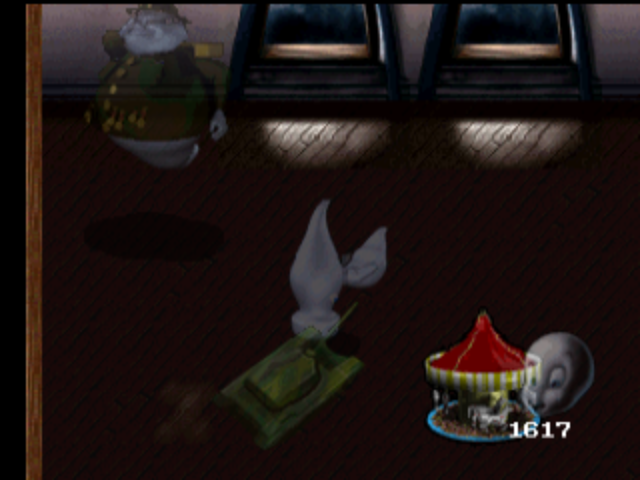 Bosses are present from the start, but can only defeated when the right moves have been learned.
The ‘boss battles’ against Casper’s dastardly uncles (whose open abuse of their ward would never make it into a modern family film) are also rubbish. If you’re unsure just how rubbish, imagine trying to implement a dynamic and real-time combat system in a slow-paced adventure game and you’re mostly there. All this is what brings things down from what could have been a 7/10 down to an middle-of-the-road 5/10. Worth a look at but probably too frustrating to complete easily.
Kept my attention for: An afternoon
Did I finish it?: Yes
Overall: 5/10
Castlevania: Symphony of the Night
I’d never even heard of Castlevania until seeing gamer nerd Americans discuss it on disparate PHP forum boards (remember them?) long after my PS1 had been filed away in a cupboard.
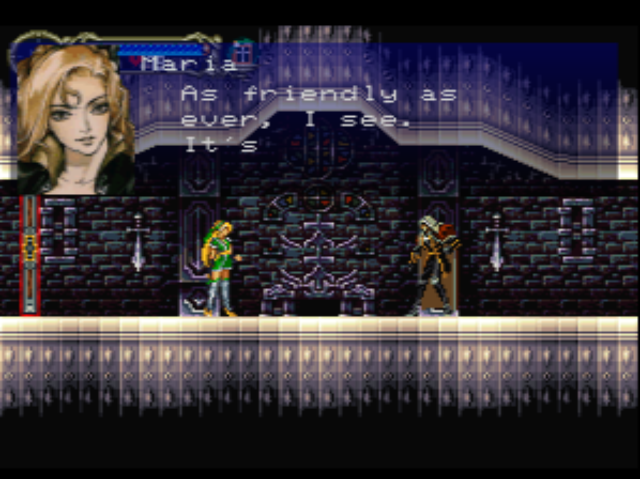 The voice acting is actually quite bad.
This one in particular tends to get talked about a lot as a fifth generation classic. An all timer, even. It also gets used as an example of how games media at the turn of the century was thoroughly ‘3D brained’, and simply couldn’t get to grips with the idea that an ‘old fashioned’ 2D side scroller could be as good as the full-busomed, three dimensional offerings we were now being treated to on the PlayStation. Scans of old magazine reviews abound, showing it being smugly brushed aside as passé, old hat in a world of Metal Gear Solid.
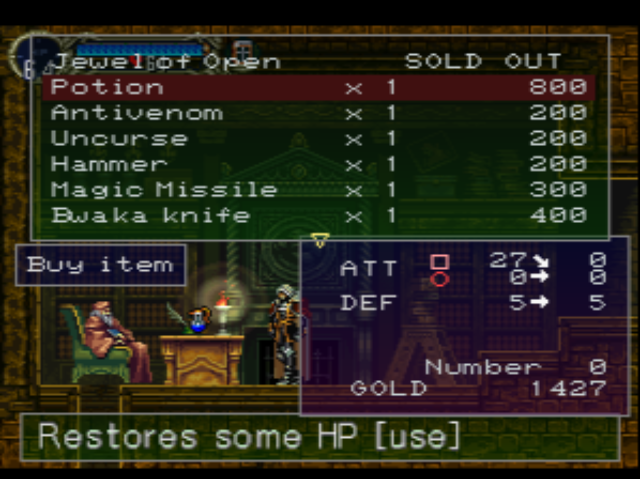 Get shopping.
Obviously, those late 90s journos were misguided, but the stuff I’ve heard about Symphony of the Night in the last fifteen years or so has always tended to indicate that it is indeed a classic with faults few and far between. So why do I find it such a struggle to get into this game? I’d tried a few times in the last few years but never really got much further than the first ‘level’. SotN is certainly an interesting setting and doesn’t suffer from the sort of hopeless control schemes and ropey 3D graphics that plague its contemporary siblings on the console, but what tends to defeat my interest with this game earlier than I would have thought is the sheer granite-block density and depth to the gameplay and layout.
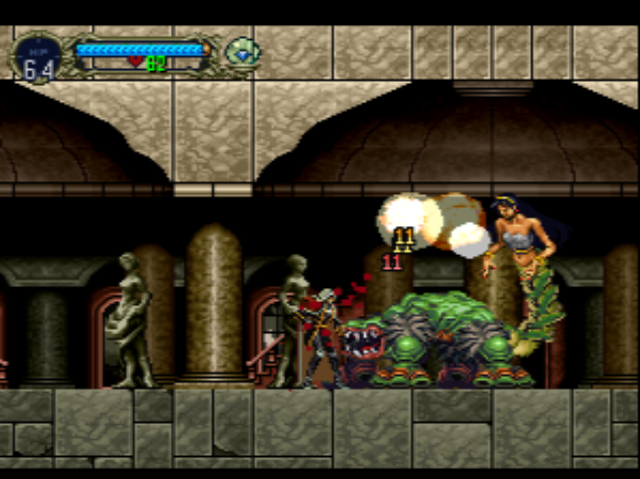 There are quite a large amount of enemies with often weird designs.
At first glance there is a clear simplicity to how the game is played - you move left and right, jump, and wave a weapon around to smack other 2D sprites - but soon you’re realising there are actually a dozen different moves and spells you need to learn in order to compete, each with an opaque, Street Fighter style exact button combination required to pull off. Trying to do so with enemies throwing things at you and moving around out of range of whatever move it is you’re trying to execute is certainly something that can become easier with enough practice, but is really just a bit frustrating.
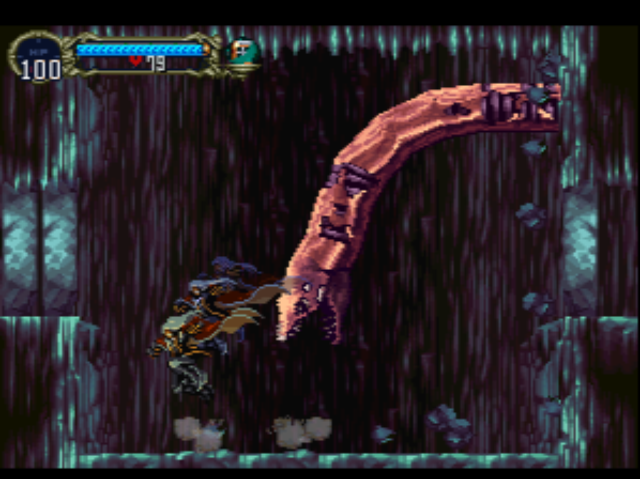 There aren’t many better looking 2D games out there.
Then there’s the level layout. I don’t know whether the game actually came with a map, or whether you had to put one together yourself, but it’s labyrinthine. The idea - the idea behind what became called ‘metroidvania’ games - is you have a rather freeform approach to a gigantic set of areas, unlocking new bits with various items and new powers as you go. A bit like Casper in that regard actually. It’s cool, I guess, but it requires you to know what you’re doing, and until that point you are reduced to just fumbling around trying to work out what it is you’re even meant to be doing in this game.
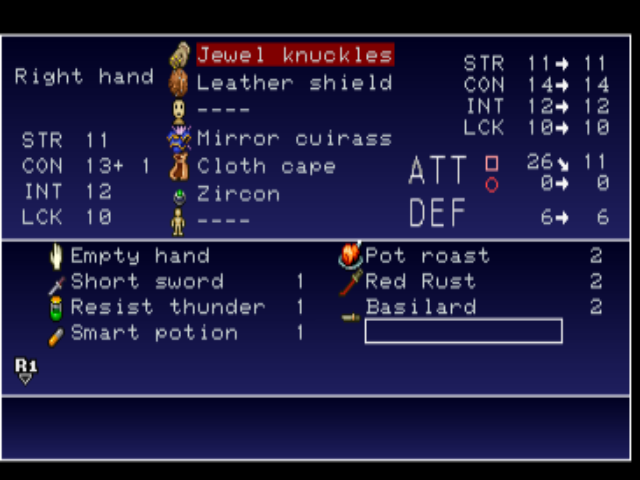 It’s half RPG half platformer.
That’s the general feeling I got. “Wow, once I memorise all the moves, memorise the map layout, memorise the enemies, memorise the spells and memorise the key items, this game will be great!”. But how long is it going to take to get there? Without a guide (which would rather spoil it), you really need long, unbroken sessions of playing, with a lot of patience and probably with a pen & paper. You need to be a kid, basically, and I wonder if all the love it gets is from now-adults who already did all the memorisation bits a long time ago, and over such a length of time that the mantra ‘up down left right square shoots an orb of light at enemies’ has long since been etched onto the grey matter.
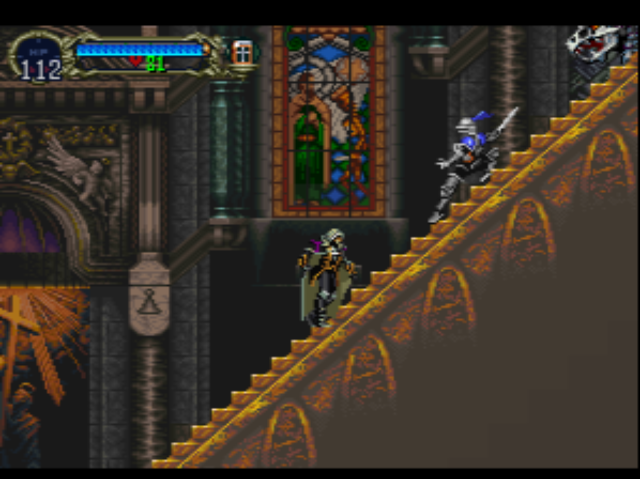 You can’t attack diagonally, so stuff like this is just annoying.
I almost feel guilty saying it didn’t jive with me. The bits I did do felt well put together, but I feel like it needs a much bigger time investment, and I have a long backlog of games to play.
Kept my attention for: An hour or two
Did I finish it?: Yes
Overall: 6/10
Castlevania Chronicles
Castlevania Chronicles is a ‘remake’, 20 years before remakes were cool (and 25 before remakes were more or less all that we got). To be more specific, it’s actually a pair of remakes - of the original Castlevania. To make it more complicated, one of the pair (‘original mode’) is actually a port of a 1993 remake of Castlevania, which was released only on the X68000 computer in Japan. The other (‘arrange mode’) is actually a remake of that remake, with extra features, for PS1. There’s your totally pointless trivia of the day.
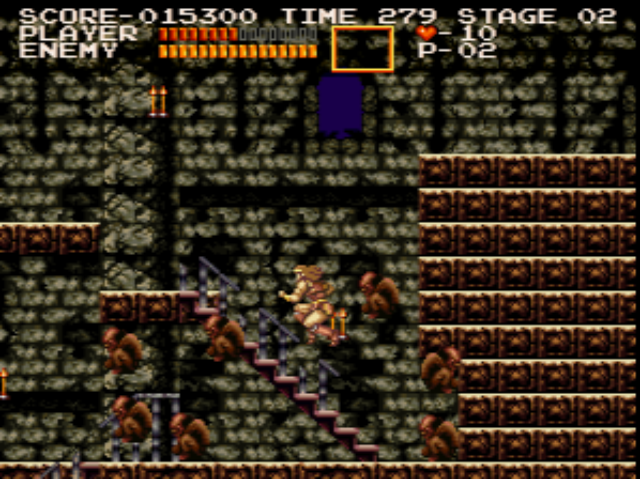 No.
No.
After diverting all my energy into trying to force myself to slog through Symphony of the Night (and giving up eventually), the last thing I wanted to do was play the same thing again, but going back to the beginning of the series on top of that. So I gave it a quick go, experienced the full clunkiness you get whenever you return to the first game in a series after playing the more mature sequels, sighed and turned it off.
Kept my attention for: 15 minutes
Did I finish it?: No
Overall: 4/10
Castrol Honda Superbike Racing
My knowledge and interest in motorsports tends to extend to ‘if the Formula 1 is on TV, I’ll watch it’ and watching back the Abu Dhabi Autonomous Racing League 2024. All I really have to say about the sport of superbike racing is that 1. It’s not the same as Moto GP and 2. I once found myself riding a zipline in North Wales with Carl Fogarty.
 I actually learned who Carl Fogarty is through I’m A Celebrity Get Me Out Of Here. Yeah I’m sorry.
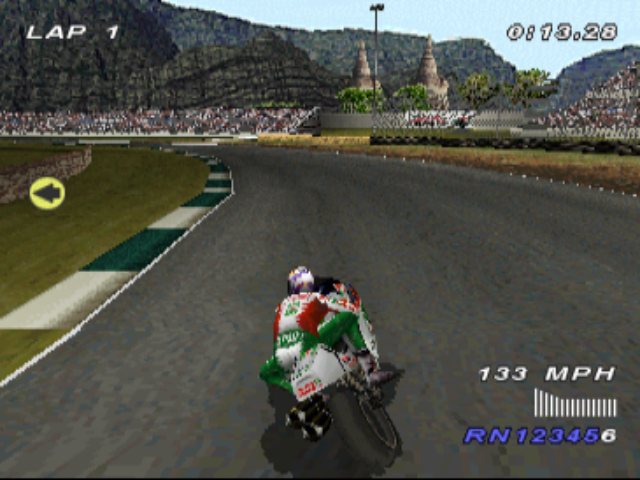
When playing Castrol Honda Superbike Racing, I was hit with a strange feeling of familiarity. Is this…“Superbike GP” from the All Star Action collection of gaming gruel? The motorcycle models and animations felt like I’d made their acquaintances before, but when I took the regretful decision of loading up All Star Action again to find out, I realised that they weren’t quite the same, but similar. A coincidence, maybe.
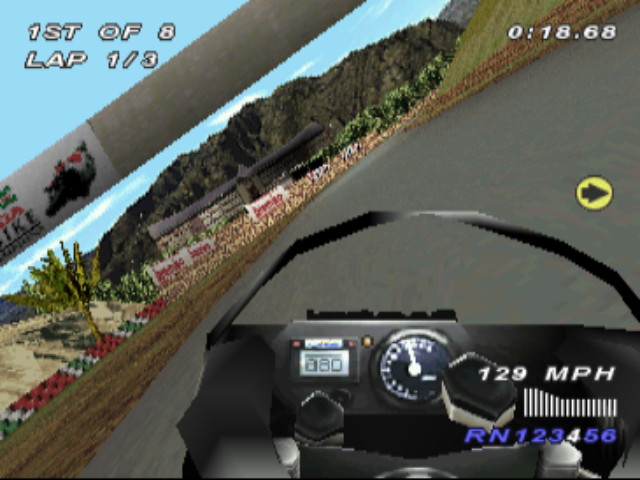 Play in first person mode if you don’t mind throwing up.
There’s more to this particular thread of thought, though. Midas Interactive, the slop merchants who backed out the likes of All Star Action and ATV Racers into the porcelain bowl of videogame ordure, were also European publishers of the two sequels to this game - Castrol Honda Superbike 2000 and Castrol Honda Superbike VTR. Perhaps a link? Looking more deeply, the developer - Interactive Entertainment - was actually acquired by Midas in 1999, around about the same time as the release of this game. So actually, yes; the spidey-sense moment I had back when playing Superbike GP held true - the reason the bike models and animations seemed so much better than what I had come to expect from Midas was actually because they’d just lifted it from their acquisition of the Castrol Honda developer a few years earlier. Another pointless mystery solved.
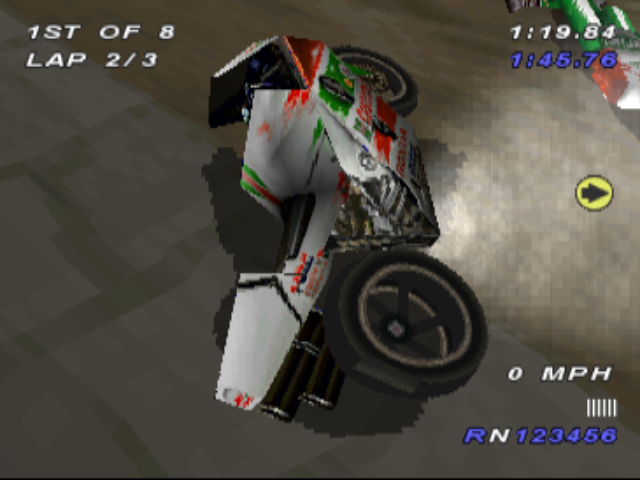 You can actually fall off your bike. No, you can’t die horribly.
Oh, the game? It’s average. The nuts and bolts are there for a racing game, but it seems they didn’t put much thought into giving the player the ‘feel’ of professional racing. The tone and atmosphere is more akin to a few motorcycle nuts having a chilled day out at the local circuit. You spend your time nipping around courses in total silence aside from the burps of your superbike engine. By default, brake assist and turn assist is switched on, which is notable only for its presence in a console racer in 1999. After a short blast, there’s nothing really to drag you back for another go on Castrol Honda Superbike Racing.
Kept my attention for: An hour
Did I finish it?: No
Overall: 4/10