Playing every PS1 game - Chronicles of the Sword, Chrono Cross, Circuit Breakers, Civilisation II
Getting bogged down with RPGs that take weeks to complete.
Chronicles of the Sword
The invention of the CD-ROM meant there were a short period in time where people shared a delusion that the Next Big Thing, now that we had storage systems that could accommodate more than 2D sprites and sophisticated beepy sounds, was going to be the “interactive movie”, where eye-wateringly highly compressed FMV was cut into hundreds of short, low resolution, low colour clips and squeezed onto the disc - or as the case may be, discs - with the idea being that the player slash viewer gets to engage in a movie equivalent of a ‘choose your own adventure’ book. It was a doomed idea due to the low disc space available, rubbish MPEG decoding tools and a lack of decent hardware acceleration but I’m sure sounded cool in the heads of publishers who didn’t really understand how hardware worked.
 2026-03-11-20-43-38.png) The visuals are pretty shocking.
The visuals are pretty shocking.
By 1996 we had more or less worked out that these FMV games were not fun to play, but that didn’t stop us getting Chronicles of the Sword. It’s technically not an FMV game in the usual flavour, but a point-and-click adventure game that uses FMV clips of horrific looking 3D environments and humans generated in 3DS Max in lieu of Z-tier acting by real people.
 2026-03-11-22-09-32.png) Arthur and Merlin at court. Why Merlin resembles an action hero is anyone’s guess.
Arthur and Merlin at court. Why Merlin resembles an action hero is anyone’s guess.
It really is pretty bad. The plot and characters are lifted from the myth of King Arthur and the mates of the circular table, where you control a Gawain who is tasked by an ridiculously hench ‘Merlin’ who bizarrely more resembles Bryan from Tekken than a musty sage, and King Arthur himself, to embark on pointless fetch quests of which your supposed mentors feel strangely reticent to help you with beyond repeating vague instructions and telling you to be on your way.
 2026-03-15-18-27-58.png) Slowly scroll through each of your items and randomly try them everywhere.
Slowly scroll through each of your items and randomly try them everywhere.
No, you’re supposed to work these things out yourself by plodding around extremely slowly, clicking on everything, picking up trinkets and engaging in irrational actions (like ‘using’ a helmet on a sandy floor to, er, fill it with sand to use in a puzzle, despite possessing several more logical receptacles) in order to continue. Once you’ve completed your task, you have to lug yourself all the way back to Merlin - a process which could take five minutes of trudging - in order to receive your next task, which usually involves going back again to where you just were.
 2026-03-11-21-45-12.png) To proceed here, you need to ‘use’ your sword on the one random pixel my cursor is pointing at on the wall.
To proceed here, you need to ‘use’ your sword on the one random pixel my cursor is pointing at on the wall.
It’s pretty much impossible without a guide or by dispensing immense patience iterating through ‘using’ every object on every possible interaction point on every screen, but it didn’t look to be particularly long when I did consult a walkthrough, so I thought I might as well see it to the finish. I couldn’t even cope with that. I got about half way through and concluded this just wasn’t very fun. At least it was interesting to hear all the Welsh voice acting, which is technically correct to the source material.
Kept my attention for: A couple of days
Did I finish it?: No
Overall: 2/10
Chrono Cross
Before I started doing all this, my experience with Squaresoft RPGs started and ended with Final Fantasy. Chrono Trigger and Chrono Cross were never released in Europe until many years later anyway, so it’s not that surprising really that I remained ignorant of all these apparently transcendent examples of the genre. I had a spin with Chrono Trigger about a decade ago on an emulator, but wasn’t quite feeling it. Normally I’ve been leaving out non-PAL games in this alphabetical odyssey, but I’ve always been curious about this one, so gave it a go.
 2026-03-30-21-17-55.png) Get ready for your typical JRPG soap opera melodrama.
Get ready for your typical JRPG soap opera melodrama.
There’s so much that can be said about Chrono Cross. My main takeaway is the depressing thought that this sort of game can actually never be enjoyed again in the way it was originally supposed to. Let me explain why. Chrono Cross is a game that provides you with so many options (while staying within the self-limiting linearity constraints of the JRPG mould), and has so much random, non-sign-posted trivia and side content at every stage of the game, that your average gamer in 1999 would still be running playthroughs for the 10th loop and watching with amazement that, after everything, if you go to this spot with this character at this time and use this item, this other plot event happens, with impacts ranging from just getting a bit of funny dialogue, to a totally different ending.
 2026-03-28-19-24-14.png) Things get weird when the game starts throwing time paradoxes at you.
Things get weird when the game starts throwing time paradoxes at you.
It was a pre-internet time when part and parcel of the culture around computer games was negotiating your way through the wild game ‘rumours’ - of the ‘Use STRENGTH on the truck to get Mew in Pokemon’ variety - where stuff your mate had heard from his cousin about how characters could be unlocked by performing exhaustingly repetitive feats of patience (and howling at a full moon) were just maybe worth trying out if you dared. Chrono Cross doesn’t just court this kind of mystery, it was plainly developed with this sort of thing specifically in mind.
 2026-03-24-21-10-26.png) There are a ridiculous 45 playable characters in the game for you to ‘collect’. They all have their own dialogue and characterisation.
There are a ridiculous 45 playable characters in the game for you to ‘collect’. They all have their own dialogue and characterisation.
So it’s a bit sobering to know that playing this sort of game in the 2020s, when every single game released has a full 4K ‘100% completion’ video walkthrough dumped onto YouTube (probably a dozen times) within hours of its release, is a bit like completing a book of crosswords when all the answers were put in brackets next to each clue - yes, you can play the game, but you feel like you’re missing a large chunk about what was supposed to make it fun at the time, which was trying stuff out and seeing what happens. When you discover, while weedling through your dozenth playthrough, that heading to an obscure room in this optional cave and feeding its occupant a random ‘mushroom’ item results in you getting a new playable character for the rest of the game, complete with special moves, dialogue and reactions to plot events, it would be impossible not to wonder just how many other secrets your game can hold.
 2026-03-23-19-48-23.png) Everything has a Hawaiian/Caribbean visual design. It’s a very relaxed game.
Everything has a Hawaiian/Caribbean visual design. It’s a very relaxed game.
As mentioned last time, it’s a testament to Squaresoft’s hubris that they would have the clout to go and try something different with the genre, and even include within it a rather profound meta-commentary subtext on RPGs and videogames in general. The game is about multi-dimensional time-travel and universe-skipping (and to be scathingly honest, makes bugger all sense), with lots of chin-stroking about time loops and sliding-doors timeline junctures - so it makes a lot of sense the fact that a ‘New game plus’ option is included and the player is more or less required to go through the same scenario over and over again to formulate different outcomes. It’s using the medium of the game itself as an in-universe plot device. It’s all coming up galaxy brain tonight.
%202026-03-18-22-01-19.png) The game really does rank amongst the best of the era visually. It might even surpass Final Fantasy IX, which came out the same year and for which in many ways this game feels like a prototype.
The game really does rank amongst the best of the era visually. It might even surpass Final Fantasy IX, which came out the same year and for which in many ways this game feels like a prototype.
Among all this you’d be forgiven for thinking that yes, this truly is a transcendent, classic RPG. It’s not really. The gameplay itself is a bit of a slog - there is a lot of schlepping back and forth around a world that is tiny by the standards of contemporary RPGs. Combat revolves around manipulating a chance-to-hit percentage; nothing is more frustrating than having your attacks miss continually, and implementing it this way was a misstep. The ropey plot also deserves comment. Dealing with time travel in fiction always requires delicate care, and Chrono Cross just stumbles through it. You can say “You need to play Chrono Trigger!” all you wish - the way the game handles plot beats is pretty poor. You sort of saunter through the first three quarters of the game, slowly losing track of what is going on, and eventually the game begins to run out of road and starts delivering the plot by means of loooong expository info dumps from random characters. There are 12 endings - which is a plus point - but the nature of there being so many means that none feel particularly definitive, nor do any tie up all the loose ends.
 2026-04-03-22-50-34.png) At the end of the game, the harebrained plot is quite literally just explained to you via walls of text. Cheers then.
At the end of the game, the harebrained plot is quite literally just explained to you via walls of text. Cheers then.
It’s still a good game, though, and an opportunity to try and put to bed a commonly held idea about the early 2000s, sixth-console-generation trend of building games with a tropical, beachy, ocean theming. Example. Common wisdom is that the trend came about as a result of newer hardware like the PS2 and Gamecube allowing developers to show off realistic water physics - well here’s the same visual design on a PS1 game, so it can’t be that simple. I think it was more just a reflection of the early 2000s ‘Y2K’ aesthetic where light translucent blues and yellows were trendy. The world was caught up in a positive, ‘the future is here’ vibe and it manifested in sun and beaches. Wish it came back, really.
Kept my attention for: Weeks
Did I finish it?: Yes
Overall: 7/10
Circuit Breakers
I went into Circuit Breakers - a game which I had never played before - armed only with a dusty memory from the back of my mind informing me that this was a Micro Machines-esque top-down miniature racer. I was about half right. It’s ‘miniature’ in some respects, and has a ‘top-down’ view in some respects, but really it shares a lot in common with Wipeout, except without the laser guns. Official PlayStation Magazine gave this game 9/10 and other contemporary reviews seemed to be similarly kind.
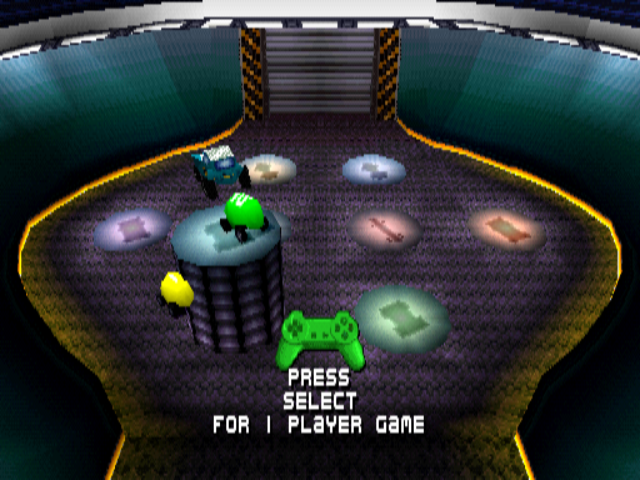 The ‘main menu’ requiring you to drive your car over options is a novel approach.
I won’t. I thought Circuit Breakers was pretty pants in the short amount of time I bothered with it. The graphics are rough as a dog (though I did just come from Chrono Cross, which makes things a bit unfair), the racetracks uninteresting, and the actual racing bit serves only to frustrate. You see, you hold the accelerator to ‘go’, in a fashion I’m sure should ring familiar to most, but then ‘turning’ is more of a swooping powerslide (this is the Wipeout bit) where the skill is found in trying to fly your car around corners as if races were taking place in a low-gravity environment. If (and when) you hit a wall, or object, or a competitor vehicle, you bump off it theatrically, lose control for a moment, and your velocity drops to a crawl, leaving you to build up speed all over again (after being overtaken by everyone else).
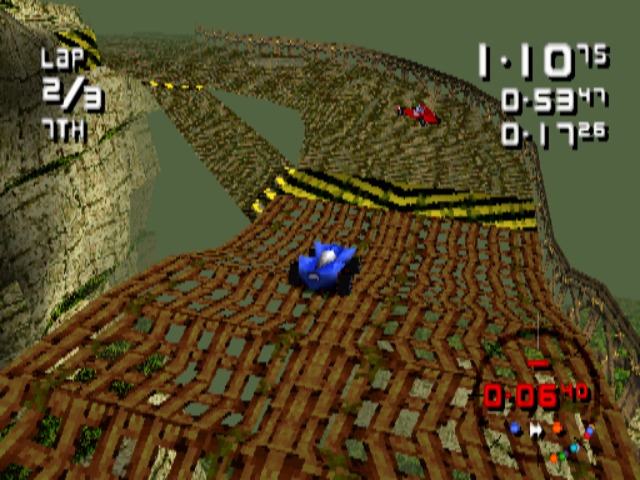 Take the shortcut if you dare. (You’ll probably die)
The problem is, the courses are all so tight and winding that a single bump will frequently morph into several bumps in a row, and a soon-to-be 8th place finish. Bumping into the walls is one thing, but bumping into other racers - something that given the speed of the game is down to bad luck more than anything - kills the experience, which I think even if you tidied up some of these problems wouldn’t be much better than average anyway. It’s clearly a game that you’re supposed to play with a friend, but to be honest I can’t envisage myself enjoying that flavour of the game too much either. Pass.
Kept my attention for: An hour
Did I finish it?: No
Overall: 3/10
The City of Lost Children
Here we are blessed with a second croaky adventure game in the same post. TCoLC is up there with The Warriors and Fight Club in the grouping of rather bizarre movie tie-in games that didn’t need to happen (The Warriors was good, though). In this case, it’s a loose adaptation of an arty French film I’ve not watched.
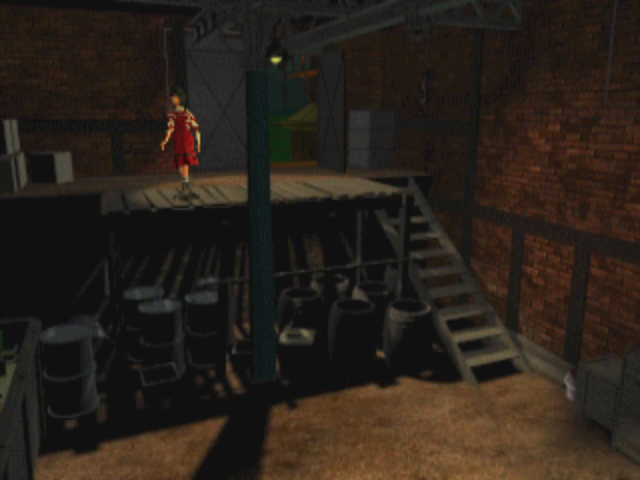 Working out what you can and cannot touch is a futile endeavour.
Much like Chronicles of the Sword, the game drops you into the middle of things (except with even less prior explanation as to what is going on that CotS, if such a thing is possible) and tells you to be on your way. The control system is total cack. For reasons unknown, whenever you mince your character into what the terrible pre-rendered backgrounds consider a solid object - like a box, or a table, or a wall - she bounces off it, emits a little yelp, and you lose control for a few seconds as the ‘bump’ animation completes. This happens over and over. Unlike, say, Broken Sword, where you are aided in your hunt for background pixels with which to interact by a cursor that changes shape depending on whether or not you’re pointing at an interactable object, in TCoLC you are provided with no such tooling. Instead, the game is an exercise in wafting your cursor around every background JPEG and hammering the X button until something happens.
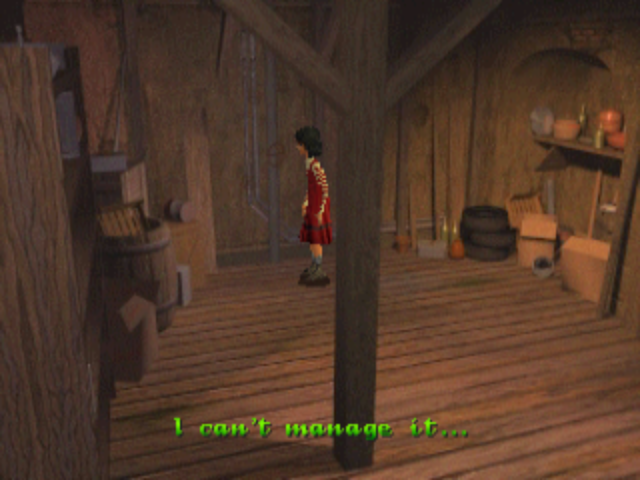 Get used to it.
In Final Fantasy I for the NES, you could use the action button on every single step, whether there is something there or not, to receive a slow pop-up text box informing you that there is indeed nothing there. The developers of TCoLC must have thought they were onto something, as the player gets to enjoy their avatar wimpily repeating ‘I can’t manage it’ thousands of times during their playthrough as they walk into inanimate objects bashing the X button. Terrible.
The music is actually OK, and deep down inside there is probably an interesting concept, but the game is too rubbish to bother trying to find out much more.
Kept my attention for: An hour
Did I finish it?: No
Overall: 3/10
Civilisation II
It’s always interesting when you come across PlayStation ports of games built with the mouse + keyboard (and higher resolution) environment of the PC in mind. These typically manifest as strategy sims such as this, and I think it’s a real struggle to name any which actually manage to pull it off at all, let alone exceed their less-deformed PC sibling. The legendary Civilisation II seemed to be one of the ones which pulled it off.
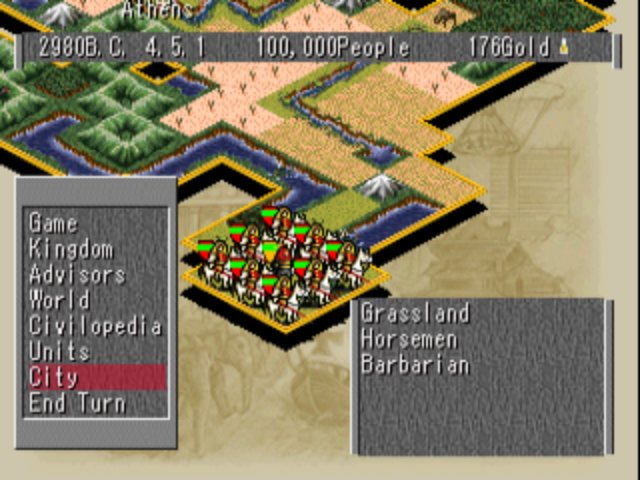 Whoops.
But did it? The only Civ game I’ve spent time with was Civ 3 on the PC, but I already know that the original Civ 2 is quite different to the PlayStation port. It’s a leggy game which they made a sporting effort of translating to hotkeys and scrollable menus to be negotiated with a controller, and the graphics weren’t much to speak of to begin with anyway. The problem is that it’s just a bit too clunky to really have a proper go with. The godawful singular MIDI music track is also the sort of thing you imagine they play on loudspeakers at Guantanemo Bay as an enhanced interrogation technique. Ten minutes with it and you’re ready to hit mute - the loop is only about a minute and a half long.
 Don’t say games never try to teach you anything.
Did people really have fun with this back in the day? I think you’d need to have a certain…mentality to have been one of those people.
Kept my attention for: A couple of hours
Did I finish it?: No
Overall: 4/10