
Fade to Black
PlayStation games had no right to be this ambitious in 1995.
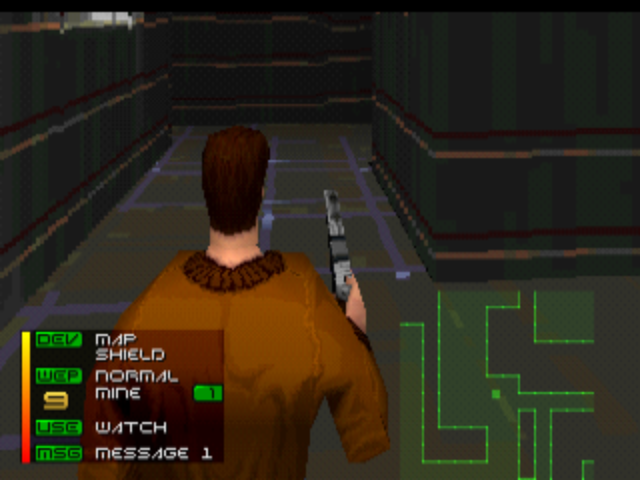 It is a very rare thing to be blessed with a camera angle which actually lets you see much of what is going on.
In fairness, this is actually a MS-DOS game that was given the textured polygons treatment for PS1, as an 'upgrade' to the very early-90s looking shaded polygons which came with the original. It wouldn't be the only time we got this. The thing is, looking back I would say that at native resolutions, much like Alone in the Dark, the DOS version probably comes out looking better despite its lack of 'detail'. The jaggies and wobble that come with 3D rendering on the PS1 really do look worse than we may have thought. One way or another, managing this sort of fully-3D environment this early in the lifespan of the console probably took some doing and would have been quite impressive. Fully 3D-rendered games from this generation all have a bit of a Japanese Echo Night sort of vibe to them, and I find it appealing.
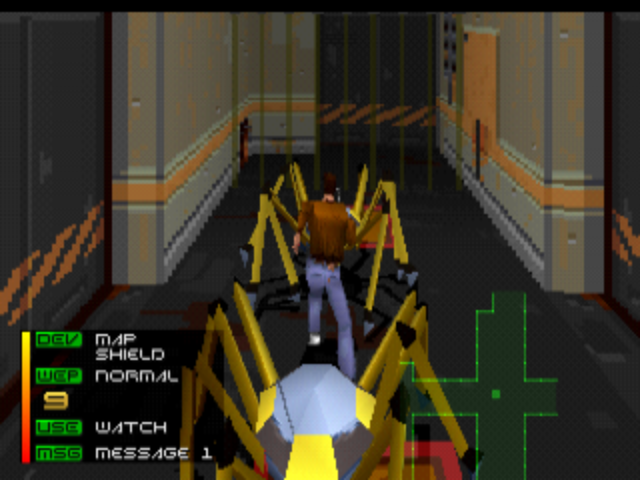 When you die (which you will), you have to wait out a 5-6 second freezeframe as the game loads the appropriate death cinematic from the disc.
The game is a bit of everything. The 'escape alone from a futuristic space prison' concept of System Shock, the 'rally behind the resistance leader giving you instructions' shtick from Red Faction, tank controls and random fixed camera angles from Resident Evil, godawful controls from Bubsy 3D, and terrible, terrible gunplay from, er, Alone in the Dark again. There's also a very balls-out cinematic sci-fi theming throughout the game, with lengthy FMVs and narrations as if this were a true dystopian 90s science fiction flick. The 'resistance leader' you communicate with is even hilariously named 'John O'Connor', in one of the most on-the-nose references you'll come across.
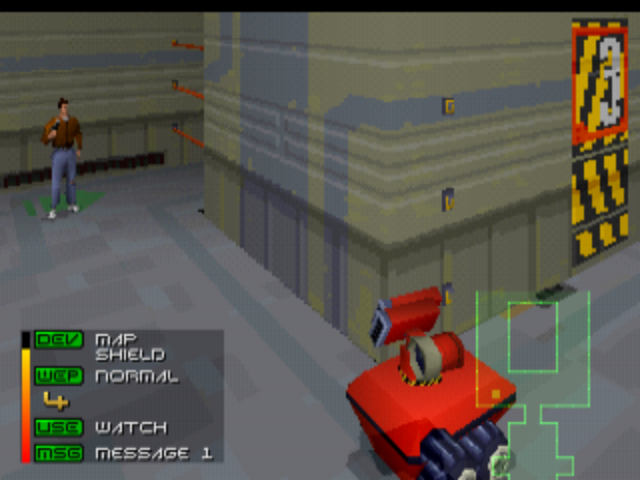 I'm coming to realise that random fixed camera angles were a bit of a cop-out in early 3D games to compensate for not being able to properly manage a free camera.
Shame that the gameplay is pants. It would be several years yet before developers worked out how to properly enable the player to control their polygonal avatar and interact with the game world. Movement is impossibly janky, orientation is confusing and the combat is dreadful and broken. This game was trading on the cool-looking 3D screenshots in magazines and the back of the case, and that was about it. The concept is interesting, but it's actually just a pretty bad game.
Kept my attention for: An hour or two
Did I finish it?: No
Overall: 3/10
Fatal Fury - Wild Ambition
This would be my second experience with the SNK arcade fighting game juggernaut, after being utterly humiliated trying to play Capcom vs. SNK. This time, I came into things familiar with King of Fighters, but not Fatal Fury. Well, they're basically the same thing. What we have here is the inevitable fifth-gen 3D-version-of-a-2D-fighter, which was a bit of a theme in the late 90s as the culture shifted to view 2D games as very passé and developers started to panic. It would take at least another ten years or so for that particular hysteria to die down. Suffice it to say this is the only 'proper' 3D game the series got.
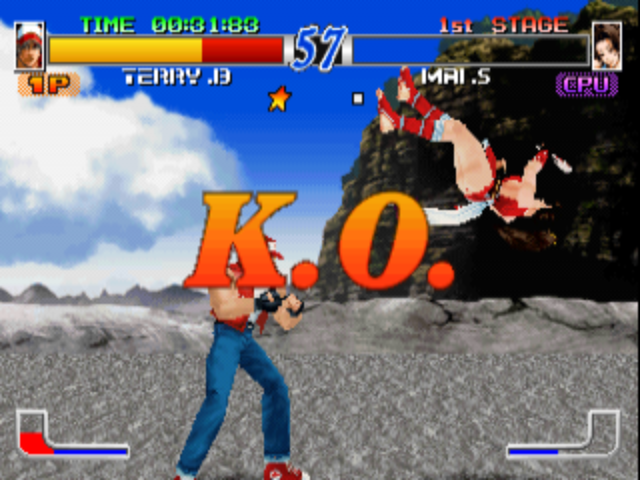 It's 2D in all but the cosmetics.
Much like Capcom vs. SNK, I found it hard. But not quite as hard. Unlike something like Street Fighter EX (the late-90s panic 3D version of SF), Wild Ambition doesn't try and adopt much from the likes of Tekken or Virtua Fighter and is instead more or less exactly the same as it always was, except the characters wobble around in three dimensions. You can do a lateral z-axis roll, but Fatal Fury let you do this in the old games, too, so no extra points for innovation, SNK. The 360 degree panoramic background technique (Google Streetview again, but for fighters) is pretty interesting at least.
 I concur.
The default arcade mode treats the player to a very, very lengthy introductory FMV, featuring the deliciously Engrish-ly named Terry Bogard in what I can only suppose is his 'origin story'. There's a lot of dramatic build-up, and by the time it ends you feel positively brimming with righteous anger, ready to die for Terry Bogard and bring his father's killer (a man who is literally named 'Geese') to justice. And...then none of it is ever mentioned again. You choose a character, do the usual round-robin of combat with the other characters, then roll credits. Cheers, then.
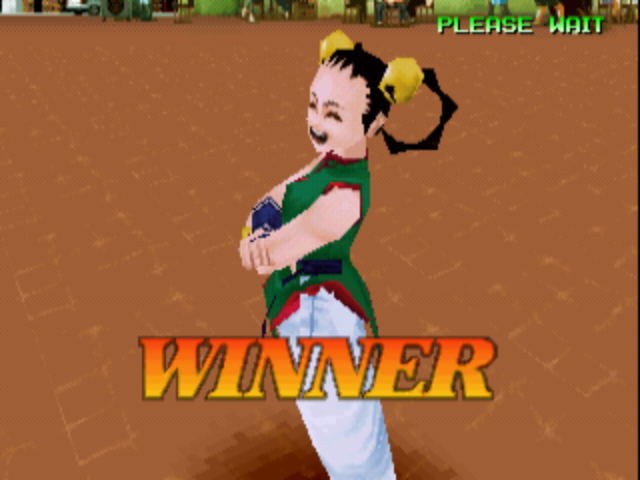 Improbably-sized victors over men with biceps the size of watermelons are all present and correct.
I got the feeling while playing that if I actually sat down for a bit and worked out how to play properly, I could see this becoming quite addictive. I've not felt like that with any fighting game previously. The 2D ones all seem far too complex and require you to come into it already prepared with all the thumb-twitching muscle memory, while the 3D ones tend to be forgiving enough for button mashers to make it possible to complete the game without knowing what you're doing. I think this could be a bit of a happy medium.
Kept my attention for: A morning
Did I finish it?: No
Overall: 6/10
Fear Effect
I came away from Fear Effect both loving it and hating it at the same time. The art design, overall mood and classic turn-of-the-millennium edgy hubris is utterly spot on. The actual execution of the game, though, is really quite rubbish; a lesson in frustration and 'what not to do' when putting a game together. Despite all that, I played it to completion and walked away quite satisfied. It's a bit like your nan's Sunday dinner - the mash is lumpy and the gravy watery, but it all looks great and you love her anyway.
%202026-10-10-18-16-50.png) There are no in-game cutscenes. Every single interaction is a FMV cinematic.
There are no in-game cutscenes. Every single interaction is a FMV cinematic.
I'd not played Fear Effect before, but I did remember its pretty bloody aggressive marketing strategy. It all got a bit 'lads' mag', particularly with the sequel (more on that later). What the game was doing was still pretty cool. The cartoonish comic-book style was pretty unique, as was its general approach to pre-rendered visuals - Resident Evil was doing static images in the background; so why not do FMVs? In reality, each background 'FMV' is rarely more than a few (heavily compressed) frames in length, looping repeatedly, but it achieved the effect it was looking for. The downside, of course, is that this choice means the game takes up four discs. At one point you even have to swap from disc four back to disc two in order to squeeze out the last few bits of the game.
%202026-10-10-17-28-31%20(1).png) The shooting bits are distilled jank.
The shooting bits are distilled jank.
Similarly (sort of) to Fade to Black, Fear Effect is a bit of everything. Is it John Woo's Resident Evil? Is it Broken Sword meets Blade Runner? Is it Metal Gear Solid in Dante's Inferno? There are elements of all of them. Sometimes it's a action-adventure, sometimes it's survival horror. It all sort of works in its own strange way.
You switch between three mercenary buddies in a crime caper of sorts, which devolves quickly from simple kidnap-and-ransom job on the futuristic streets (or rather, rooftops) of Hong Kong, through some sort of shamanic voodoo conspiracy, and finally ends with you gunning down ghosts and zombies in Hell itself. They didn't warn you about that tonal shift in the marketing. I was here all this time thinking it was a Matrix knock-off. The writing is pretty good for the time, though the guy doing the voice of the Australian sidekick is totally hopeless, managing to at once sound American, English and a bit South African, but never particularly Aussie. It's quite off putting.
%202026-10-11-15-52-56.png) It all gets a bit weird toward the end.
It all gets a bit weird toward the end.
It's a good thing that there's so much other stuff going on to distract you, then, because actually playing the game is such a pain that I know I’d otherwise have knocked things on the head quite early. Tank controls get a lot of flak generally, but it's more of a stupid hysteria than anything; with pre-rendered backgrounds and points-of-view flipping around frequently, they're a sensible mechanic. The main problem is the combat, which is shocking.
%202026-10-11-11-08-23.png) Some boss fights are just luck of the draw more than tests of skill.
Some boss fights are just luck of the draw more than tests of skill.
The game uses a 'lock on' system which requires you to point your character in the general direction of an enemy and wait for a special targeting reticule to appear on-screen (much like Chase the Express). This in itself is a fiddly job. You then need to balance a series of tasks all at the same time - firing your weapon; holding down L2 and a directional button to theatrically 'roll' about in order to dodge incoming fire; letting go of L2 to re-orient your character with the directional buttons to obtain the lock-on again (whilst being filled full of holes by your enemies); then continuing to tap X to fire, wasting ammo all the while as the first few shots of any burst pursue their habit of missing while your lock-on sorts itself out.
%202026-10-11-12-33-37.png) Sneak up behind and bonk him on the head. Or jankily bump into him and alert everyone nearby.
Sneak up behind and bonk him on the head. Or jankily bump into him and alert everyone nearby.
You can only take a few hits before dying, and then have to reload from a saved game. Keystone Cops-esque deaths are a constant occurrance. Either by flipping around into another screen and not knowing which way you need to face, or by getting blasted from all sides while you try and slowly turn your character around. It's bloody awful. Combat is also one of the main hooks of the game, too, with enemies on every other screen. Getting stuck on the geometry happens from time to time as well, as the pre-rendered backdrops are married up a little sloppily in places. Visibly stepping on top of something that should be part of the background isn't as common as in something like The Crow, but it sticks out when you see it.
%202026-10-11-12-35-57.png) One of the more infuriating puzzles. One wrong step and it's instant death, with the nearest save point about 10 minutes back.
One of the more infuriating puzzles. One wrong step and it's instant death, with the nearest save point about 10 minutes back.
The other problem is that it is just a bit too difficult. In the quiet moments between gunfights, you are often asked to complete Myst-style logic puzzles to continue, by making use of various visual and audio clues, which to be honest are just a bit too arcane in their solutioneering. It's easy to get stuck and wonder what the hell it is you're meant to be doing. The game could have been improved a lot by just making the combat a bit less of the focus (it's possible to sneak up on a few enemies for one-hit-kills - introducing the possibility of 'stealth runs' through the game would have been a nice move) and upping the interaction with the environment. The UI needed a rethink, too, with you having to endlessly scroll one way or another through a lengthy item list each time you wanted to 'use' something or change weapon.
%202026-10-11-16-34-04.png) Spoiler alert.
Spoiler alert.
Despite all that, though, as I said before I came out of things both loving and hating it. The good elements are really good; the bad are really bad. Not enough to make it a truly great game, though, I'm afraid. It's almost there. The feel and tone of the game makes you nostalgic for a Y2K period that's never coming back. You won't get anything close to this sort of thing in the 2020s.
Kept my attention for: A weekend
Did I finish it?: Yes
Overall: 6/10
Fear Effect 2: Retro Helix
Retro Helix, whatever that means. This game's publishers famously used some quite on-the-nose imagery to promote the game, with a particular fixation on a girl-on-girl relationship which was only ever vaguely hinted at in the game itself. All the character models were subtly redone, and the voice actors swapped out.
%202026-10-11-18-48-30.png) Teenagers hoping for something saucier than this would be left (mostly) disappointed.
Teenagers hoping for something saucier than this would be left (mostly) disappointed.
Fear Effect 2 is, fundamentally, a better game than Fear Effect. The flaws with the original were so clear and obvious that there would have been no real excuse for cynically pushing out a mission pack for the first game with '2' slapped on the end. At the same time, as we've learned, there is very fine line to toe between fixing what's bad and throwing the proverbial baby out with the proverbial bathwater by losing sight of which elements made the original good to begin with.
%202026-10-11-20-01-02.png) The opening level is a cracker.
The opening level is a cracker.
Kronos and Eidos didn't throw the whole baby out, but maybe an arm or leg. They also left some of the dirty water pooling at the bottom of the bath (that's the longest I'll stretch this metaphor). Combat, by and large, is still pretty much the same. You point your character at the enemy, wait for a lock-on and then mash the X button, while using the L2 button to roll about like an loon. It's still subpar. Instead of tearing it all out and just copying Resident Evil (which is what Parasite Eve II - which shares many elements with Fear Effect - did), what they've done is tweak some of the things 'around' the combat mechanics which contributed to the aggravation and piss-boiling. Combat is less of a common occurrence generally, enemies are slower to react and don't come in such large numbers. You also have far more health than the pathetic 4-5 hits before dying one had to tolerate before. It doesn't make things any less janky, but the punishment for getting tied up in a knot is less severe.
%202026-10-14-19-36-41.png) Combat is still clunky, but no longer induces bouts of controller-throwing.
Combat is still clunky, but no longer induces bouts of controller-throwing.
With the combat smoothed out somewhat (while still being quite rough), there is a bit more of a focus on puzzle solving and adventure-game-style 'use X item in Y place to access Z'. The fixed puzzle sequences are good. Unfortunately, the inane inventory-cycling to 'use' every item in every possible place in order to figure out what to do next is actually almost as bad as the combat was in its predecessor. What a screw-up. The final act of the game involves passages of play so utterly vexing to slog through without a guide (or a postgraduate-level knowledge of Chinese mythology) that it pretty much ruins it. These gameplay problems are so annoying, because once again everything else that is built up around Fear Effect 2 is great. The writing is funny and the voice acting decent. The visual design and tone, whilst not really as good as the original, is still better than most PS1 efforts out there.
%202026-10-14-21-43-44.png) Puzzles are on the whole a bit easier, but not all of them. Case in point.
Puzzles are on the whole a bit easier, but not all of them. Case in point.
The plot and narrative is all very weird, though. It's almost as if two wholly separate plots were considered, and the developers couldn't choose between the two, so tried to mush them together. The first few levels in a spooky underground aqueduct filled with dead bodies and scared-delerious biohazard workers, and following that a stealth section through a fancy dinner party, seem like they're setting up for something quite cool, but then things just totally go off-piste entirely and change into a Tomb Raider with zombies romp and end up going through a series of otherworldly Chinese-themed locales whereupon the game ends with a sequence of extremely lengthy exposition dumps. Little of it makes sense, and those first bits in the aqueduct feel like memories of a totally different game.
%202026-10-15-20-14-30.png) The last few hours make bugger all sense.
The last few hours make bugger all sense.
I'm still a fan of Fear Effect. It felt like a lot of ground was being prepared for a continuation on the PS2, but for various reasons it never happened. A pretty rubbish-looking third entry did finally appear thanks to an indie developer and crowdfunder cash in 2018, but I'm not sure I can really count it as being 'real' in my mind. So we're left with the two late-era PlayStation games and a wondering of what might have been. FE2 is once again the better game, but it's a win on points rather than a KO.
Kept my attention for: A few days
Did I finish it?: Yes
Overall: 7/10
Next, there is the small matter of almost ten years of FIFA games to get through.