
Devil Dice
One of those games that occasionally appears in ‘obscure PS1 gems’ clickbait listicles (though not that often - too obscure), Devil Dice is a puzzle game based around quite literally rolling dice, in a manner of speaking.
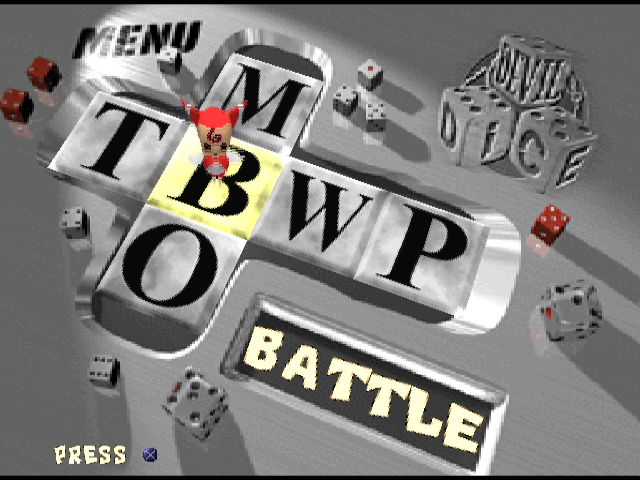 Whatever happened to quaint interactive main menus?
The received wisdom about Devil Dice is that it was originally the offspring of Net Yaroze - a (rather quaint) consumer-grade PS1 dev kit that allowed keen bods to create uncomplex PlayStation games, and now goes for four figures on Ebay. Devil Dice was said to be a hobby project which had life breathed into it by someone at Sony Japan with an eye for a winner. Time has shown this inspirational developer story to be made up, or at least lost in translation. Net Yaroze games had to be loaded entirely into RAM in order to run, and the PlayStation was furnished with a piddling 2MB. Google Search AI says that yes, even the final published edition of Devil Dice managed this, but I seriously struggle to believe such a thing. The game is simple, but not that simple.
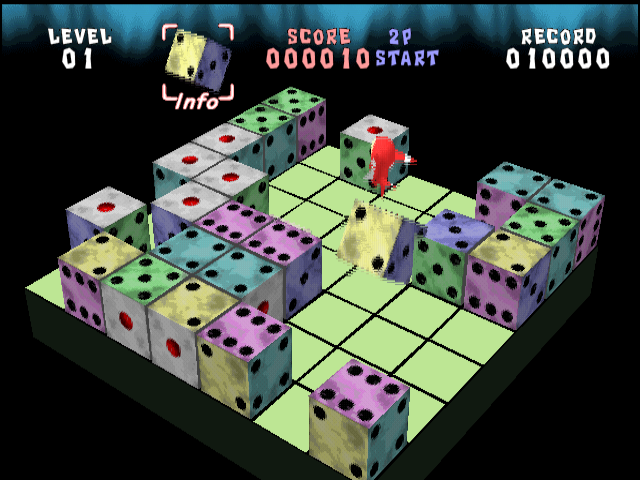 It’s actually way harder than you’d expect to not just lose track of what you’re doing completely and run around aimlessly.
My favourite thing about the game as far as I’m conerned is the soundtrack, which jams with Ape Escape-esque smooth late-90s techno head-nodders. It reminded me a bit of Rez, so I looked up the credits. Apparently it’s a chap called Kemmei Adachi, who funnily enough did end up working on some later Ape Escape games. He’s also credited for involvement in pretty much all of the Gran Turismo series, and you know what? I can believe it.
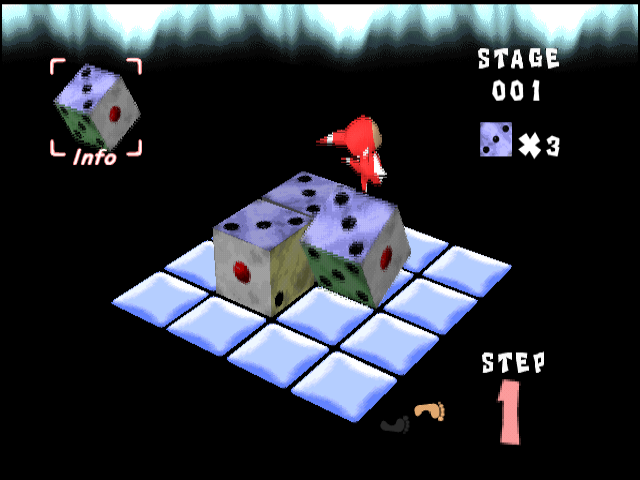 Puzzle mode is potentially even more fun than the actual thrust of the game.
The game is played by ‘rolling’ - it’s more tipping - dice over on a grid layout so that the dots ‘on top’ line up with those on adjacent dice. Match a few in a row, and the dice will slowly disappear. The complexity comes from the fact that you can’t always easily know which side of the die will go ‘face up’ when you next roll it in a given direction. The jeopardy then comes from you trying to make these sorts of spacial perception calculations in your head whilst more and more dice appear on the grid - if it fills up, you lose. It’s a bit like Tetris in this respect, except…a lot harder. The game encourages you to constantly keep moving and lining up the dice, and it’s incredibly easy for your brain to just lock up completely as you find yourself blindly hopping around the grid like a moron, tipping over dice randomly and lining up nothing at all.
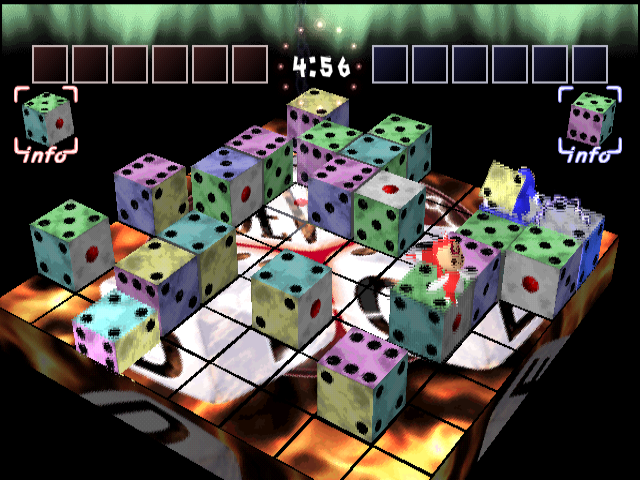 Up to four players can play against each other in a chaotic mess.
There’s a more cerebral ‘puzzle’ mode, which removes the stress-inducing time attack gameplay for a series of set ‘levels’ where you need to line up some dots within a fixed number of ‘moves’. Get it wrong and your miniature devil avatar theatrically screams before you are instructed to go again. This could have fairly easily been the whole game, actually, and the levels start off simple but require progressively more chin-stroking as the properties of the dice start to change (for example, they may slide around) and you have to start hopping on and off dice in quick succession.
It’s the sort of game that I’m surprised hasn’t made a comeback more recently as one of those cheap indie clones you get on Steam or digital console stores, as I can tell that once you get to grips with it and start to learn by heart the exact combinations of rolls to get from a four to a two in the right place, it would get very addictive in the same way that Tetris can. But right now, just a bit too hard.
Kept my attention for: An hour
Did I finish it?: No
Overall: 6/10
Dexter’s Laboratory: Mandark’s Lab
Not being one of the kids cursed with Sky television meant that Cartoon Network (and all the other kids’ TV channels intended as a delivery system for American merchandised animated slop to be funneled along the cathode ray tube into the eyes and ears of the youth) passed me by almost entirely. Dexter’s Lab was one of those things I only heard about at school and pretended I was familiar with. The inevitable game tie-in was certainly not something I would have been interested in, not least because I would have known it was likely to be a turd.
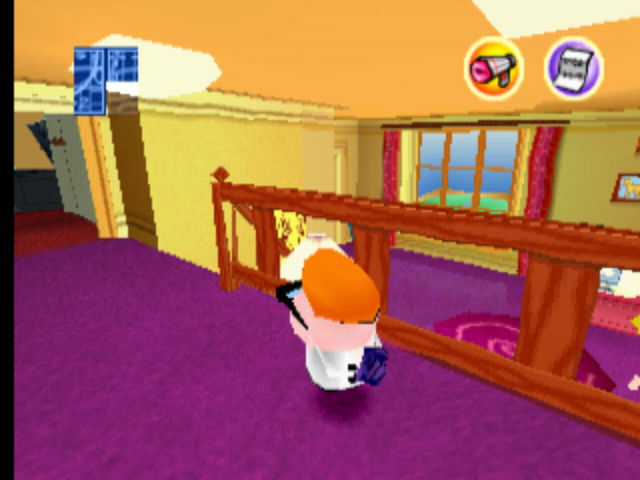 Seeing a cartoon represented in 3D was actually a bit of a novelty.
I’d call it a turd, but earn such a classification requires a game to actually do enough bad things to warrant it. Dexter’s Laboratory doesn’t do much at all. In a simple cartoon-turned-3D environment hub level - your house - the game is more or less a collection of dull minigames with bits of loose exposition in between. Is it based on an actual episode of the cartoon, a la Gotham City Racing? I’ve no idea.
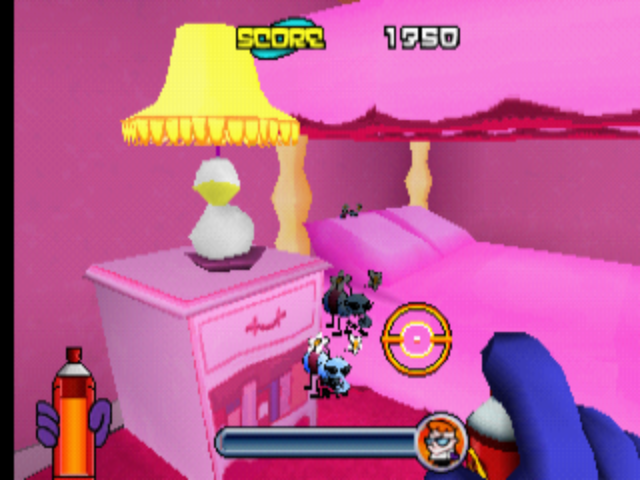 Kill bugs by hammering the X button and waving it around madly. It’s not even hard, just really, really boring.
The minigames are about as complex as operating a vending machine, and frustratingly force you to repeat them up to five times before you can clear the ‘level’. Doing so will give you - if you’re lucky - a short cutscene before you just move onto the next one. Maybe something diverting for the Dexter’s Lab obsessive, but did any really exist?
Kept my attention for: An hour or two
Did I finish it?: No
Overall: 3/10
Diablo
A lot of energy used to be wasted in the late 00s in endless internet arguments about the split between ‘casual’ and ‘hardcore’ game-playing. It’s as cringey now as it was twenty years ago, but the cartwheeling onto the scene of the waggle-icious Nintendo Wii, put together with the burgeoning market for mobile phone games (not that the smartphone had fully arrived into the hands of the hoi poloi) meant that there was a sort of gripping fear that ‘proper’ gaming as a concept was for the birds, and we would soon all be sucked up into a saturated market of sudoku ‘brain training’ diversions and motion-sense pilates simulators. You’d soon be having to wrestle the controller off your mum. How right these soothsayers turned out to be is a matter for debate.
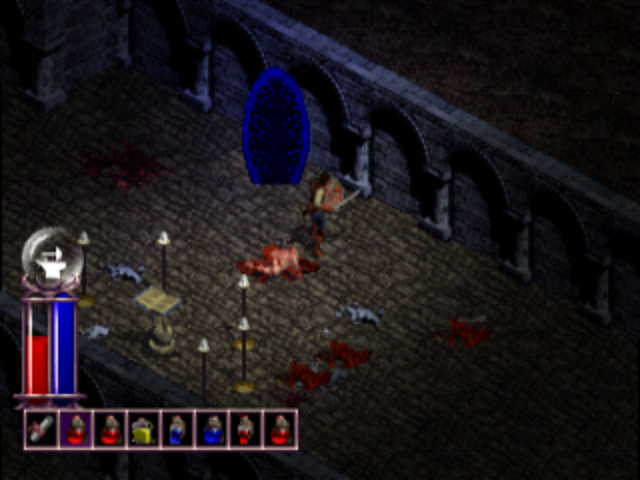 Create portals to get back home. They only work once, though.
My opinion on said matter is that the doom prophecies did turn out to be sort of right, but in a bit of a diluted way. Nobody uses their Wii Balance Board anymore, and we still get a torpid rebadge of Call of Duty and Assassin’s Creed every few months; but the ‘casualised’ elements of those noddy games that arrived as consoles went truly mass market have ended up being transplanted into every other game through a kind of hidden osmosis. The ‘new’ Tomb Raider games are a great example of this. The original thesis behind Tomb Raider was one of trial-and-error, punishing gameplay, head scratching as one figures out what to do next, and dying a lot. I played one of the new ones a couple of years back and it’s totally different - the game quite literally lights up the path to proceed, cannot stop giving you written on-screen instructions as to what you’re supposed to be doing and thinking about, and the game is easy enough to make death a relative rarity. In fact, ‘Game Over, man’ in most modern games barely happens at all unless you’re particularly unskilled or physically challenged. Games that don’t follow this formula become notable simply by their omission of these QoL game design shibboleths - just look at the mythology around Dark Souls.
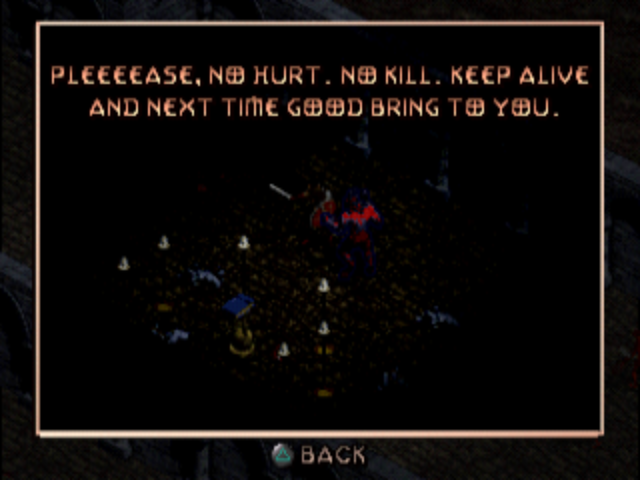 Occasionally you meet actual real characters amongst all the legions of murderous undead, which makes for a bit of a jarring tonal shift when it happens.
I thought about all this while playing Diablo. It gives you a short FMV opening, some rather barebones character-creation tools, then just throws you into it. There are no instructions, no several hours long tutorial-as-plot sequence explaining each of the game’s mechanics in extreme detail, not even a rough idea of what your presence in the game world is even for. You’re dropped into a bit of empty land a few yards away from a medieval hamlet, and it is on you to figure out what your purpose is here. Granted, not every game was like this in the 90s, but this approach wouldn’t have been particularly unusual.
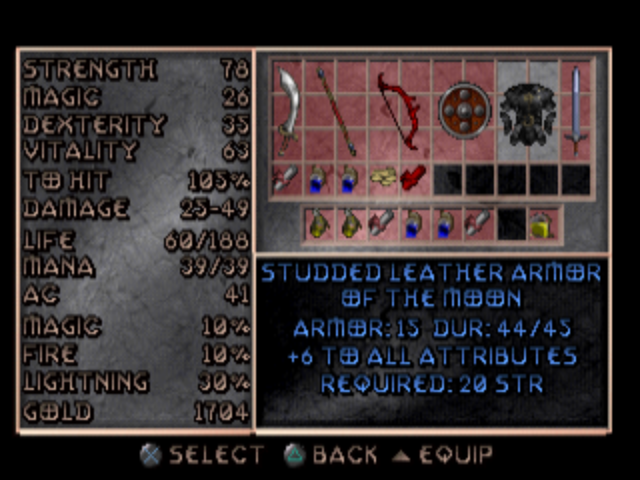 All your favourite Inventory Tetris is present and correct, and all the more infuriating due to your inability to rotate items.
I played through Diablo once to completion, rather boringly setting myself up as a brawny warrior type. I tried it on PC a few years back and didn’t get particularly far; ironically probably largely to do with the lack of direction given to the player which I just talked about. The PS1 port doesn’t get talked about very often, which had me thinking it probably wouldn’t be much good. I was wrong. The setup is a bit like Blood Omen, with the isometric sprite-based design, but Diablo doesn’t have anywhere near as much slowdown and jank. There’s a fair amount of loading as you move between dungeon levels (thank God for fast-forward), but otherwise this is a really good effort at porting a PC RPG to PS1; something that rarely happened and almost always failed.
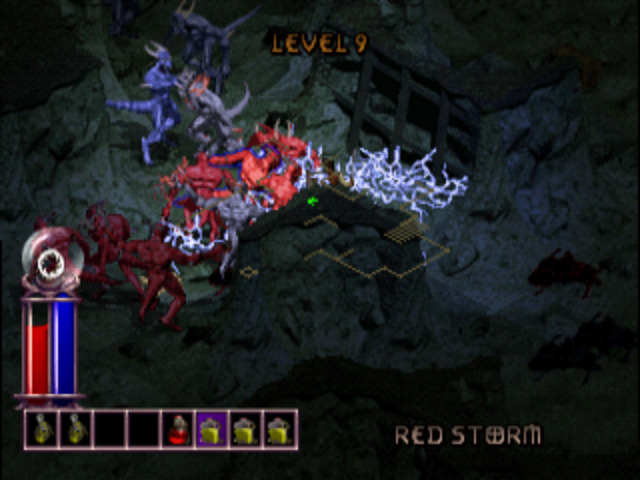 As you venture into the deeper levels it becomes quite easy to get immediately and thoroughly ganked. Honestly, the swarm can arrive in moments.
The gameplay manages to be at once complex and laughably simple. To attack, mash the X button - you don’t need to bother targeting an enemy, or even turning to face them; the game asks you to chill as it does that bit for you. All that is asked of the player is to place their character adjacent to one of the assorted hellspawn, and the software will take it from there. This isn’t how it works in the PC version, where you’re required to use your mouse to jankily point yourself in an attacking direction and risk swishing away at nothing. I think the PS1 approach is actually better, despite it seeming like there isn’t much to it - there wasn’t much to it to begin with, so why not just remove the clunkiness? The complexity comes from building your character and making decisions about which gear to equip for your next forway into the 16 circles of hell (Why 16? Not for me to ponder). Most equipment is randomly dropped by enemies, which is a bit annoying as they can only be killed once; if you clear a level and don’t get any good kit then you’re just SOL. The idea is that you can start a wholly new game with your same character and try again, which is cool and all but isn’t really for me. The game can be a bit of a slog, particularly at the final few levels, and the idea of starting all over was highly un-appetising.
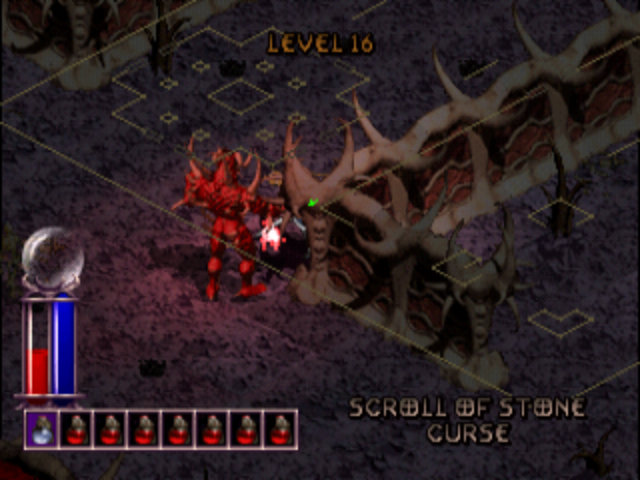 Diablo himself. He’s actually a bit of a loser as long as you kill all the minions around him first.
Once you get the hang of it, things get fairly easy, though it can be quite slow going. I think you’re supposed to get more fun out of things by playing in the co-op mode, which you get the impression is how the game is set up to be played. Not a huge deal though, it’s still a great game.
Kept my attention for: A couple of weeks
Did I finish it?: Yes
Overall: 7/10
Die Hard Trilogy
I feel like Die Hard Trilogy should make for mandatory playing for anyone who wishes to properly understand what the PlayStation achieved. In 1996, this was considered one of the console must-plays; it was virtually scratched onto stone tablets that what stood before us was an ambitious and high-value undertaking offering three high quality, full-fledged games (one per film in the Die Hard, er, trilogy) for the price of one. By 2001 and the time of the PS2, this would have looked and tasted reminiscent of a painfully old hat. Gamespot furnished DHT with a frankly absurd 9.4 out of 10 rating, claiming each game as being ‘right at the top’ of its respective gaming genre. It’s not an appraisal one could ever give now. In the space of five years, a console’s own games were being rendered wholly obsolete. Try and explain that to someone who just bought Grand Theft Auto V (released 2013) for the tenth time on their fifth different device.
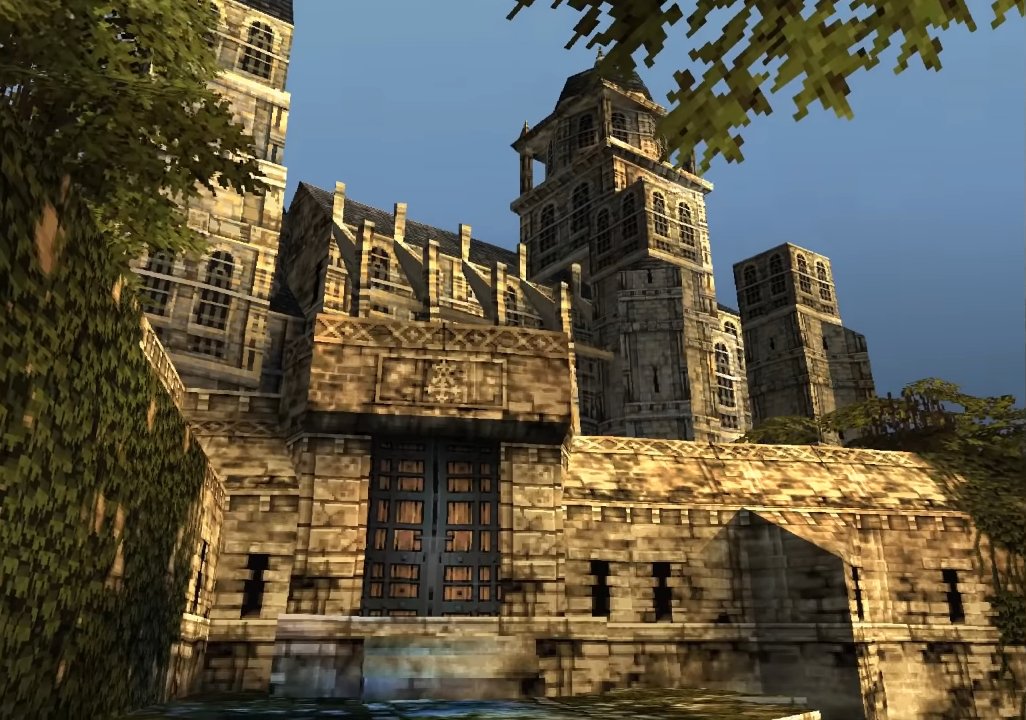
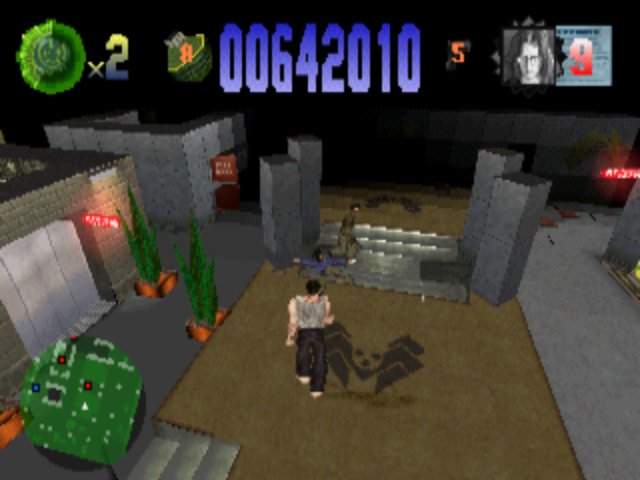 Nakatomi Plaza never looked so terrible.
The ‘game’ offers a selection of three sub-games. People try to pretend that each one could stand by itself as a title, but they’re kidding themselves and were probably also kidding themselves in 1996. Die Hard is a simple third-person shooter with godawful graphics and suspect controls, Die Harder is a simple rail shooter with godawful graphics and suspect controls, and Die Hard with a Vengeance is a simple Twisted Metal sort of game with utterly shocking graphics and terrible controls. Now, I’m not one to target poor graphics too much, as it isn’t necessarily a game breaker (I did just play Diablo, after all), but the visuals on offer across Die Hard Trilogy are aggressively ugly. It’s wild to think that a few years later this same hardware was giving us Vagrant Story.
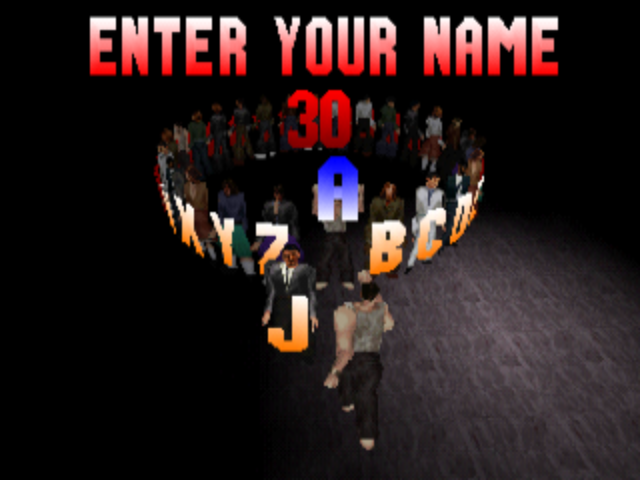 Shooting civilians to create your name in the high score screen is pretty novel, I guess.
The best of the three games on the disc is probably the first (Die Hard), as it plays the least like an extended minigame. The controls are clunky but run just about smoothly enough to navigate the level without getting stuck on the geometry too much. It’s not exactly complicated - kill everyone on the level, save the hostages (or don’t, the game remains strangely ambivalent about whether you free them or gun them down while thundering “Yipee Ki Yay”), run for the exit before a mystery bomb explodes and kills you. Just do that twenty times to complete the game, if your patience can drag you that far. It’s unsatisfying.
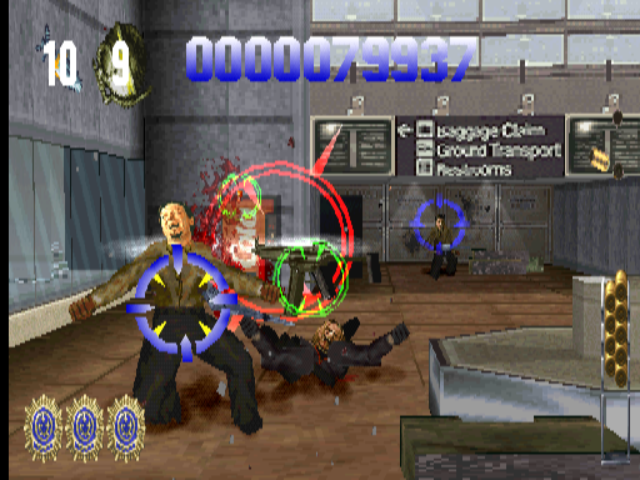 The enemies aren’t actually 3D models and are in fact simply layers of 2D sprites.
That leaves the on-rails shooter and drive-em-up. While the rail shooter won’t have been doing anything new in 1996, you could be charitable and say that the ‘drive around a fully 3D, freeform New York’ idea probably did some things that few had tried before. The graphics are rougher than a dog’s arse and I couldn’t figure out how you were supposed to reverse (a necessity when bumping off geometry at random angles is constant), but it all runs at a stable framerate and you have to respect the attempt. As a game it is the least enjoyable of the three, though.
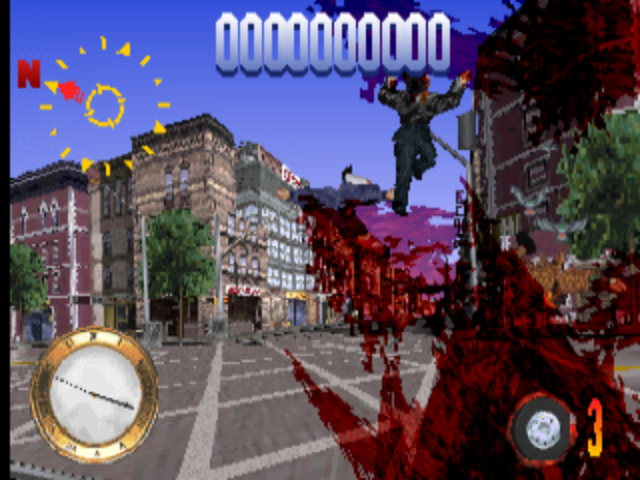 The windscreen wipers cleaning up the blood of the pedestrians you run down is pretty funny and yet another thing you’d never get in a modern game.
The reason to play it is to catch a glimpse of a truly early-3D old fashioned game built entirely from the ground up, in a time when people were so caught up in the fuss about 3D that they never stopped to think whether the offerings were actually any good or not.
Kept my attention for: An hour or two
Did I finish it?: No
Overall: 3/10
Die Hard Trilogy 2: Viva Las Vegas
The proof of my previous thesis that 1996 reviewers had no idea what they were talking about when they hosed praise all over Die Hard Trilogy can be found with just a short hop to its cringily named sequel, which released four years later; which might as well be several millennia in 90s terms. While it looks a bit better (not a particularly taxing endeavour), it doesn’t actually play any better. It got middling reviews, which were justly deserved.
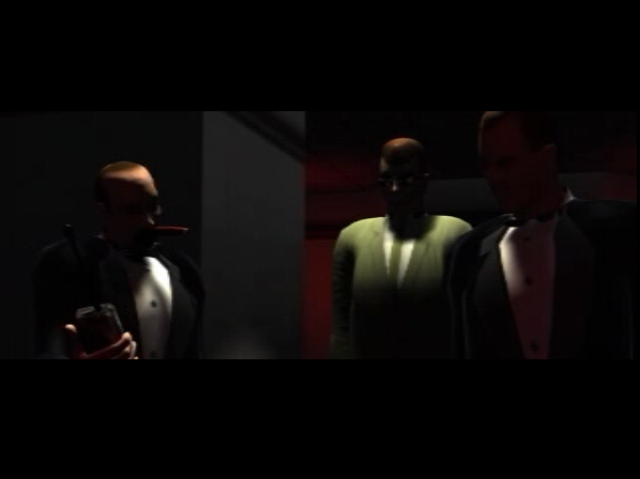 Hiding the fact that you couldn’t get Bruce Willis’ likeness by just keeping his face in shadow in every cutscene works every time.
DHT2 bins the loose connections to the movies which the first game strung together and instead opts for a wholly original story (and by original, I don’t mean any more than that they bear no relation to the movie franchise - ‘terrorists take over a casino’ is about as original a plot concept as ‘James Bond sleeps with woman then dumps her’). It also drops the ‘three games within a game’ idea and instead attempts to mush the different genres into a singular series of levels, swapping in and out between third person shooter, rail shooter and driving game. It rather raises the question “Why is this still called Die Hard Trilogy?”. The world has more important problems to solve.
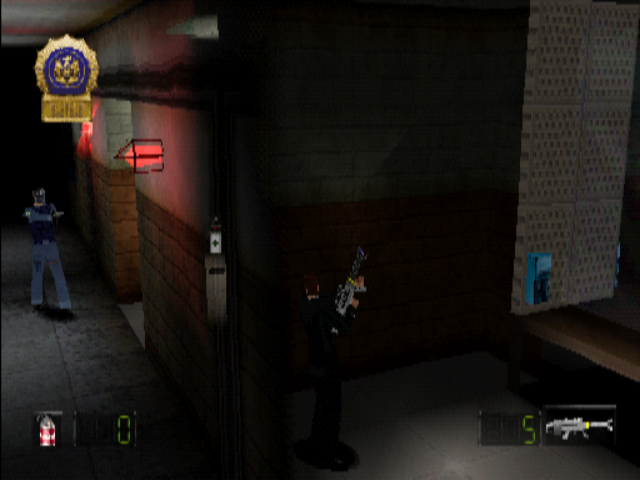 It looks slightly better, but plays slightly worse.
I only managed to sample the first third-person shooter level, and about three seconds of the rail-shooting level 2, before the game crashed. If the car segments offered a Gran Turismo level of pure driving simulation, I guess I’ll just never find out about it. Based on the other two levels I think the chances are pretty low. The TPS approach is very Tomorrow Never Dies. TND sucked, but it didn’t suck quite as much as DHT, which in its attempt to do a bit of everything finds it just can’t commit to pulling off any of them. Trot around gunning down respawning goons and getting stuck on doors, while a very low-rent Bruce Willis sound-a-like repeats bored remarks like “Happy trails” and “Come to papa, scumbag”. Yawn.
As for the rail shooting, I’ll share one of only 30 or so frames I got to get a look at. DHT1 looked better.
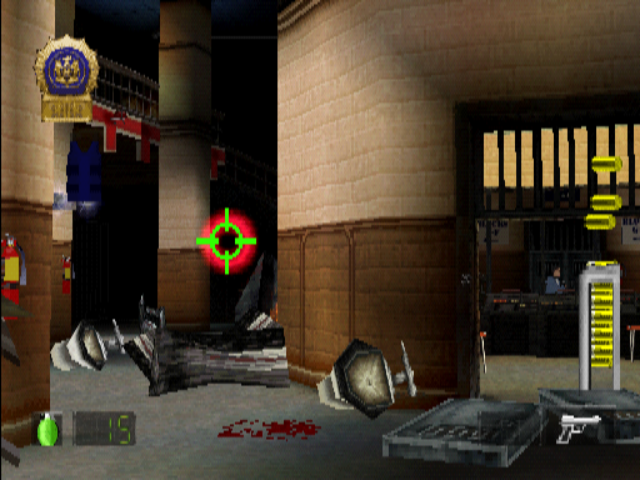 That’s not very christmassy.
Kept my attention for: An hour
Did I finish it?: No
Overall: 3/10