
While common knowledge would tell you that there were three Final Fantasy games on the PlayStation - VII, VIII, and IX - the truth is that thanks to remakes and ports, there were actually a whole bloody nine. While Square-Enix today might exist as a zombie publisher, whose sole remaining purpose is to re-hash the FF glory days with limitless spinoffs and 'remasters' to feed to the cohort of 30something-40something legacy fans who grew up to be software developers with disposable income (er...), you can actually trace this fetish for computer game necromancy (or, often, Frankenstein's-monstering) all the way back to the turn of the century.
By the end of it all, if you owned a PlayStation, you could play through every single numbered Final Fantasy release, aside from FFIII, up to FFIX. There was also Final Fantasy Tactics, but that never reached Europe until a PSP port many years later. This trend of Europe being ignored comes up a lot.
The first two were bundled together on two separate discs as Final Fantasy Origins, and Europoors had to wait until spring 2003 for a release - by which point most people had put their PlayStation consoles into a cupboard to make room for the PlayStation 2. The primary curio about this package deal was that each of these was a not a 'remake' of the original NES release per se, but actually a port of a Japan-only Wonderswan Color handheld remake. This explains why they look rough as a dog. To sweeten the deal a bit, one or two short introductory FMV sequences were thrown into each disc. Cheers then.
What's nice is that while the visuals get a (dubious) facelift, the actual guts of how the games work are kept the same, which is something that can't be said for the (many) future remakes, which all made the game easier or simplified in various ways. The Origins editions only make some QoL improvements (like the ability to sprint through the very, very long dungeons, and larger inventory space), which means that if you want to play the original two games 'the way the developers intended' but can't bring yourself to slog through the NES original, the lesser-known PS1 ports are the best option.
Anyway...
Final Fantasy Origins - Final Fantasy
A thought occurred to me whilst playing FFI. With something like a book, or a film, one can be used to reading Twilight or whatever, or watching Marvel superhero movie dreck, yet still be able to pick up The Lord of the Rings or watch Gone With The Wind and at the very least be able to see it through to the end and understand it. Switching medium to a RPG game like Final Fantasy, though, it's just not the same. This is not a game that you could just hand to someone whose RPG experience is Final Fantasy XVI or Baldur's Gate III, and expect them to complete it, or even know what on earth to do.
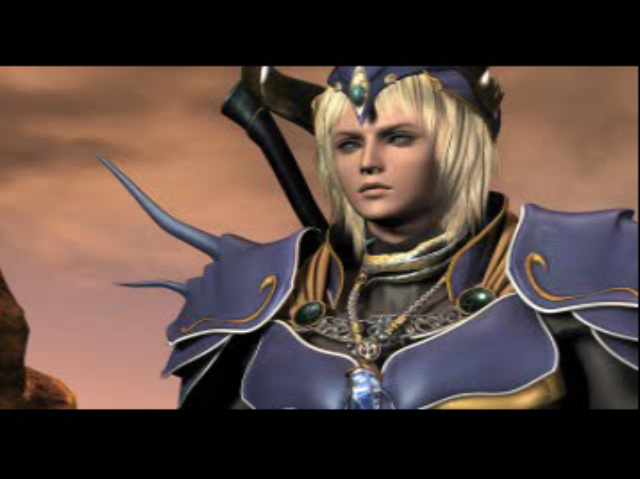 The original game has no particular plot beats or specific characters, so the opening FMV they threw in is actually pretty irrelevant.
It's actually just...bad. It's not a very good game. It may have been perceived as incredible at the time, but unlike Gone With The Wind, one could not today take Final Fantasy on its merits and say that this is a good game. In fact, I struggle to see exactly how or why someone could sit there back in the 80s and pour in the amount of time required to grind oneself to the finish. All I can think is that the whole idea of a video game was still a bit of a novelty, and alternate options were limited.
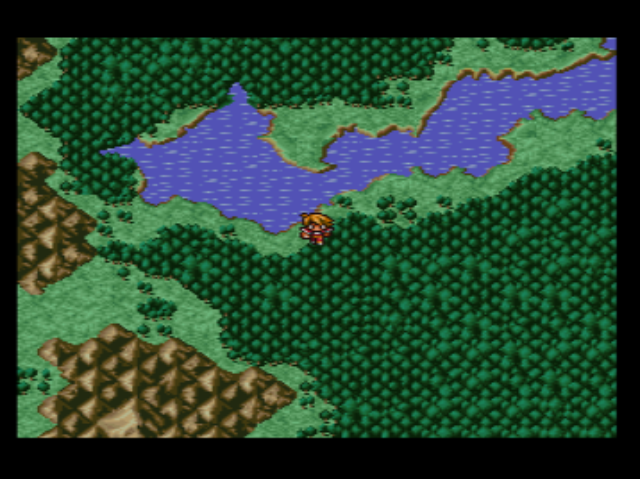 Know where you are? No? Well great, because that's the whole point. Now, walk in a random direction and turn back when it's a dead end.
I played and completed FFI on 'normal' difficulty (an invention for the purposes of the remake - there is an 'easy' mode) and holy hell, it is an absolute slog. I've done my fair share of monotonous EXP grinding in RPGs, but never have I found myself grinding specifically for money for an hour. Everything is set up to impede progress not through tests of skill, but through getting lost, not having enough money, having to odyssey across the overworld to get anywhere, or having to complete dungeons in enter > grab treasure > exit > repeat loops rather than in one go. I will discuss each of these concepts in detail.
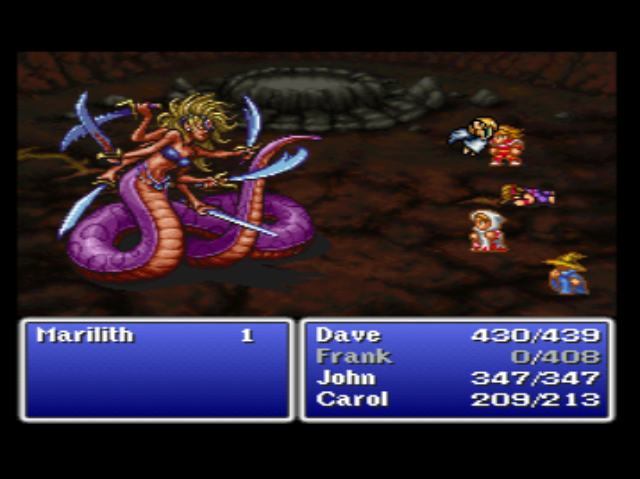 This boss would actually reappear 20 years later in FFIX (among a few others).
My understanding is that the original game included a walkthrough to the first half of the game in the game manual, which can at least somewhat account for the near-total lack of pointers as to What You're Supposed To Be Doing that you pick up naturally. No other conversion of the game furnishes you with such a toolkit, though, so players of Origins were stuffed. Much of the game has you only working out what to do next through intense trial and error; at one point only working it out by quite literally travelling backward across the overworld to an early village, and asking a random NPC whose dialogue text has suddenly changed - and even then his instructions are clear as mud. Without a guide, the game is as close to impossible to conclude as you are likely to see.
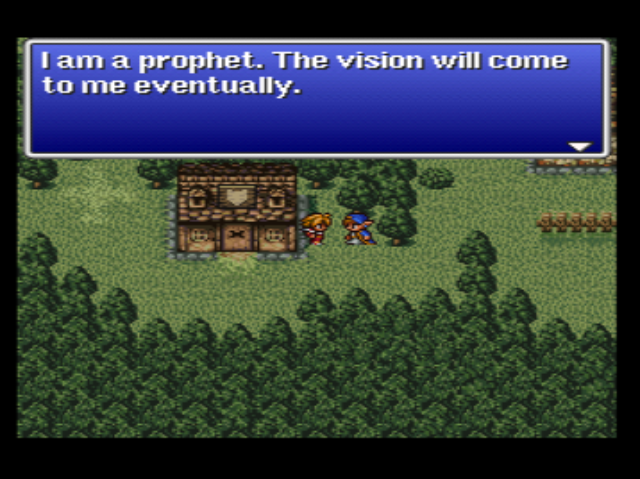 Come back to this random guy much later in the game at exactly the right point and he will tell you where to go.
Everything costs money, and a lot of it. The player is expected to kit out their warriors in weapons and armour in shops, but also buy spells from spell shops, for each mage in the party. Spells inflate in price rapidly, beginning at 100 gold for the entry-level spells, all the way up to the higher level spells costing between 40,000 and 65,000 gold a pop. The only way to make money (outside of finding lump sums in chests) is through battle grinding, and you can expect in the late game to pick up a few grand per battle. It's totally nuts. Toward the back end of the game, you genuinely cannot continue until you scrape up the coins to pay 40,000 gold to some desert peddler to buy a single-use key item.
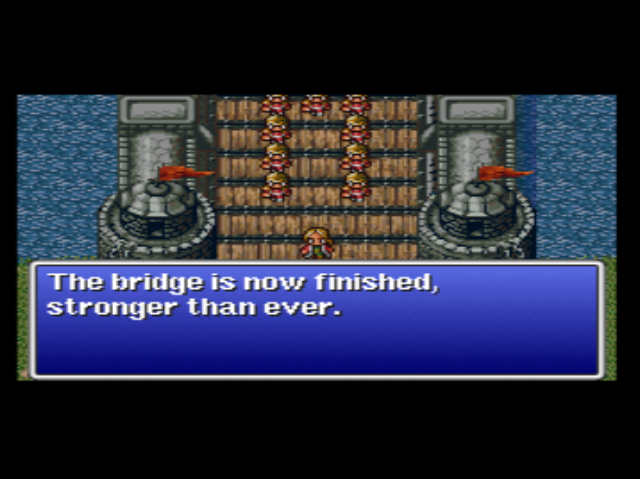 They created a few short 'cut scenes' for the remake to try and give you some sort of world flavour.
Much like the rest of the FF games, the game offers you a slowly-growing garage of vehicles with which to traverse the overworld and get to where you need to go. While it giveth in this regard, it also taketh away by also forcing you to hike incredible distances (in a direction which is difficult to intuit) in order to arrive at your destination. The sail ship takes you over water, but random battles pepper you along the way. Airship journeys are battle-free, but landing points are deliberately placed half a continent away, forcing a lengthy walk through monster-infested overland just to get to an inn.
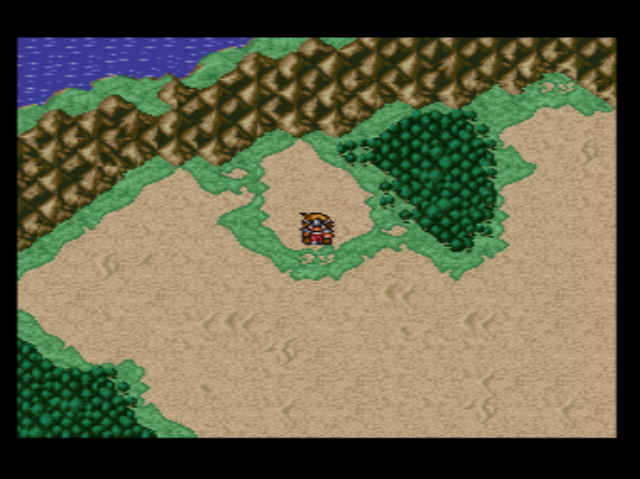 You have to stand on this very specific tile on the overworld in order to progress the game. You get no indication that this is the spot.
And the random encounter rate is obscene. Battles occurring on consecutive steps is a common occurrence. Completing dungeons requires high levels and immense patience. Spells are limited to around 2-6 casts before requiring you to stay at an inn (many miles away), and all dungeons have a tricky boss at the end, so 'using up' your cast pool and leaving yourself with nothing for the boss is a constant risk. White mages have Cure spells, but you need to keep hold of them - the only alternative healing facility are Potions, which in the late game require almost 20 blasts per character to heal up your party, so even buying up 99 of them has you running out very quickly. The final dungeon pushes this difficulty to absurd limits by not only being terribly long, but it also forces four other boss fights onto your exhausted warriors before the final one, and you can't just teleport out and heal up after each, either. It's not fun, I'm afraid.
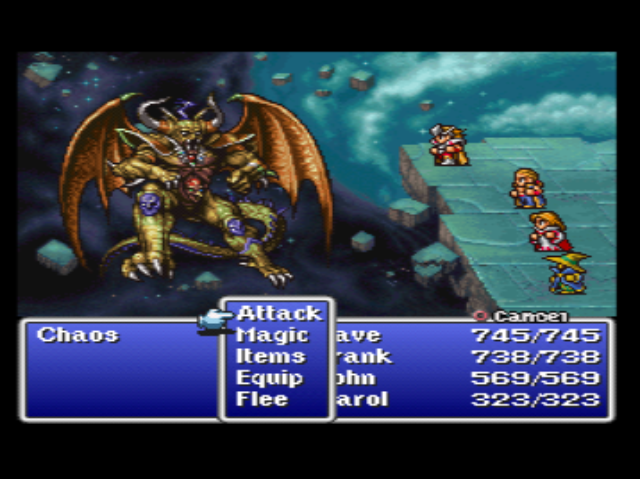 Proof I did it.
So did people actually complete this sort of game back in the day? It can only be through weeks of trial, error, and repeated attempts at the same thing. Maybe that's the difference; that sort of gameplay was expected in those days, and isn't now. I only tolerated playing this one because it was Final Fantasy. That's it.
Kept my attention for: A week or so
Did I finish it?: Yes
Overall: 3/10
Final Fantasy Origins - Final Fantasy II
FFII is a clear evolution on FFI, but given the original's flaws it wouldn't have taken a particularly large stretch of ingenuity to make it so. Common wisdom will tell you that FFII is the weakest game in the series - an ill-conceived levelling system and poorly-signposted overworld enemy placement (meaning accidentally walking into an area with overpowered enemies being common) are reasons typically forwarded to place this one bottom of the pile - by unwashed masses who haven't ever actually played the game.
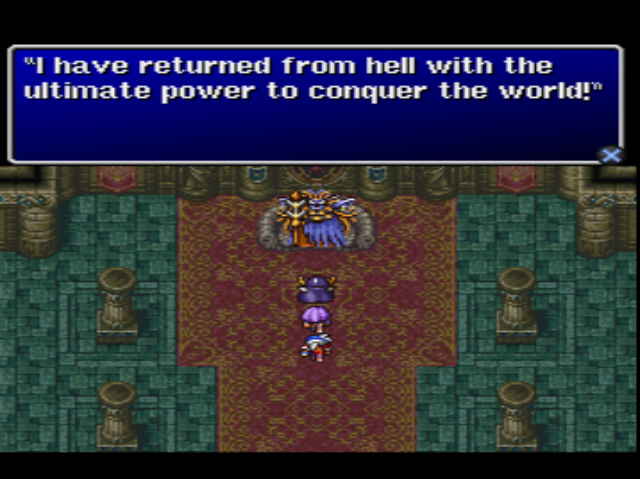 Alastair Campbell shortly before rising from the dead to start a political podcast with an ex MP.
They wouldn't be wrong about the aforementioned flaws, but it's hard to honestly conclude that this game is worse than FFI. The original is less 'broken' in terms of mechanics, but the lack of direction and volume of pointless grinding required doesn't make it a fun game. Truthfully, FFII isn't much cop either, but you can at least see where they were trying to go with it.
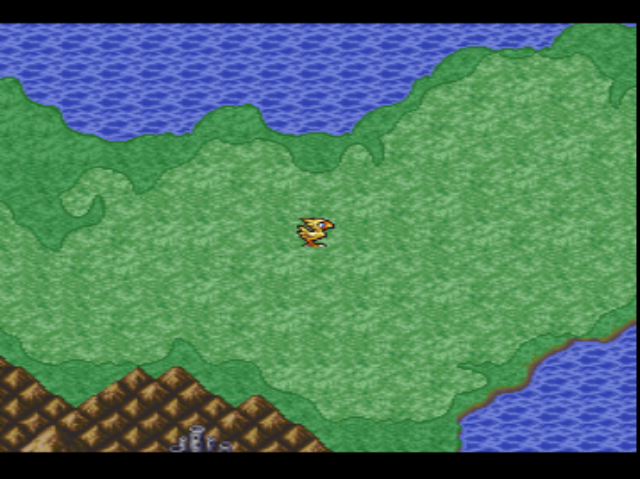 Get ready for more hiking.
FFII's primary difference from all the others (bar FFX, I suppose) is that it bins off a traditional 'Lv.1, Lv.2...' experience gain system in favour of something far more ambitious - there are no 'levels'; instead, each individual stat is improved over time, the more that particular stat comes into use. So for example, the more you take damage, the more your total HP increases. The more you attack with a sword, the more your strength and sword skill increases. The more you evade attacks, the more your evasion increases, and the more you cast spells, the more your intelligence stat increases. It all sounds pretty intuitive in theory.
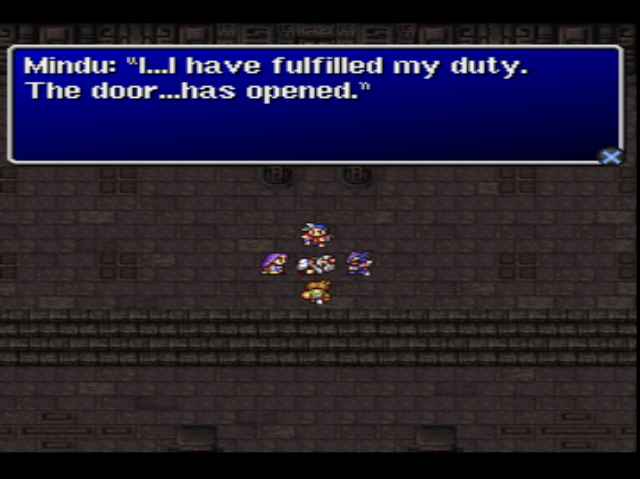 The game tries to introduce a bit of limp melodrama involving characters who you know barely anything about.
Unfortunately, the RPG equivalent of 'Instagram vs. Reality' hits the ground incredibly early on, as it slowly dawns on the player that the system they are playing with actively encourages them to play the game in stupid ways. Equipping expensive armour means you take less damage, meaning your HP rarely increases, and equipping powerful weapons means the battles are over before the enemy has a chance to give you a kicking, so none of your stats increase (aside from your skill with a particular weapon, very slowly). It means that through much of the game, your elite noble warriors are adventuring against the forces of evil dressed in shorts and t-shirt and armed with butter knives, to ensure they can at least make it to the next dungeon halfway strong enough. Of course, there is the much-ridiculed alternative of simply having your characters bash each other on the head; this works, but to be honest isn't particularly required and is tricky to set up.
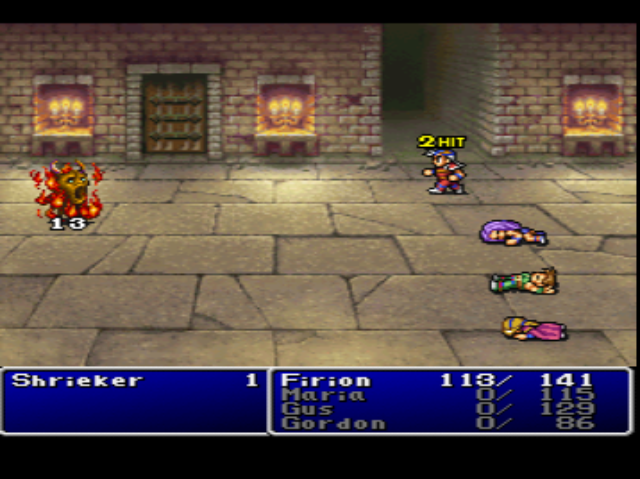 The game is littered with random enemies that are overpowered and can easily wipe you out before you know it.
There is a lot to be critical about with the core stat/combat system, and unless you've carefully planned things in advance it isn't hard for your game to reach a sort of dead end as you limp along with a group of ineffective characters who are competent at nothing and weak as piss. But I could be here forever. The other main deviation from FFI is that now, your characters come with names, and speak, and there is a - pretty bloody loose - overarching plot. It's an early attempt at one of those 'narrative' things so you have to cut it some slack, but suffice it to say that for all the potential this approach seems to indicate early on, there is zero character development, no particular plot 'events' and to be honest it's a game where you might be halfway through the 20th maze-like, eight-floor dungeon and suddenly think "Wait, isn't this just FFI with dialogue?". The extremely long dungeons and long lengths of time trekking around the overworld definitely give you that feeling.
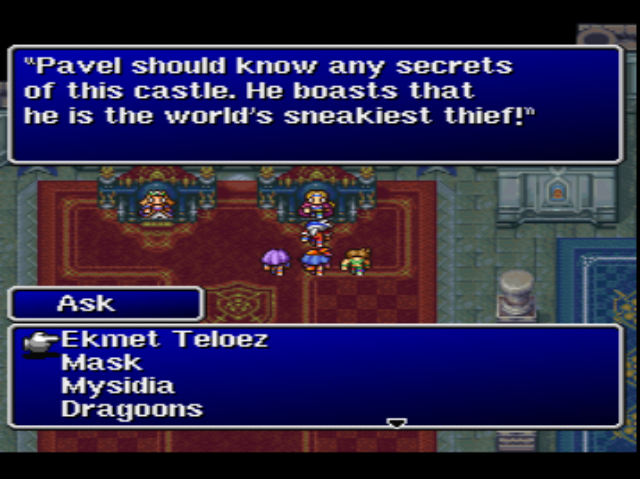 The short-lived keyword memorisation feature.
There are a few other changes. You can no longer use items in battle, and instead have to 'equip' a maximum of two to each party member. This is, of course, totally useless and means you are entirely reliant on healing spells to keep people in shape. But remember - healing party members in battle means that they end the scrap in prime condition, and therefore don't grow their max HP, so you are better off letting them lie in a heap and manually use a heal spell outside of battle. But remember again - using spells outside of battle doesn't help improve your max MP, but it does 'level up' the spell itself and cause it to use up more MP with each cast. It's stuff like this that just makes it all a real pain to play.
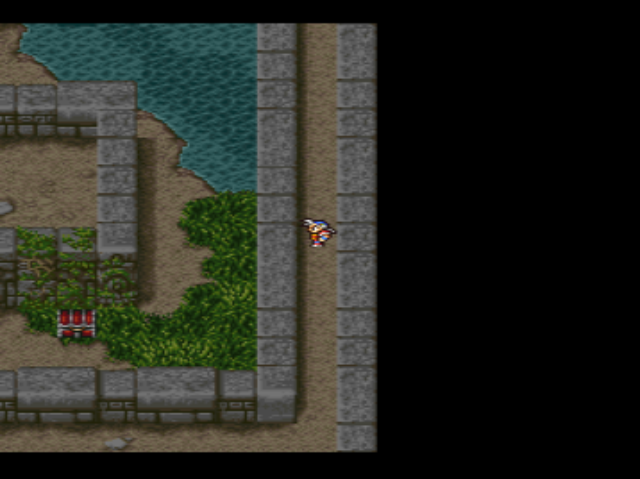 There is an invisible shortcut in the wall here. Sometimes just randomly finding these things is mandatory to progress.
While FFI felt like it started off hard and got a bit easier as you went on, FFII is more the opposite, where it gives you a certain grace window to get to grips with how it's all going to work, and then steadily starts throwing tougher and tougher enemies at you with longer and longer dungeons. Enemies you fight as end-of-stage bosses frequently start appearing in random battles not too long later, and there are an inordinate amount of enemies that hit just a bit too hard and take little to no damage, turning random battles into mini-boss chip-damage slogs where some bad timing will have you being one-shotted and needing to reset through no particular fault of your own.
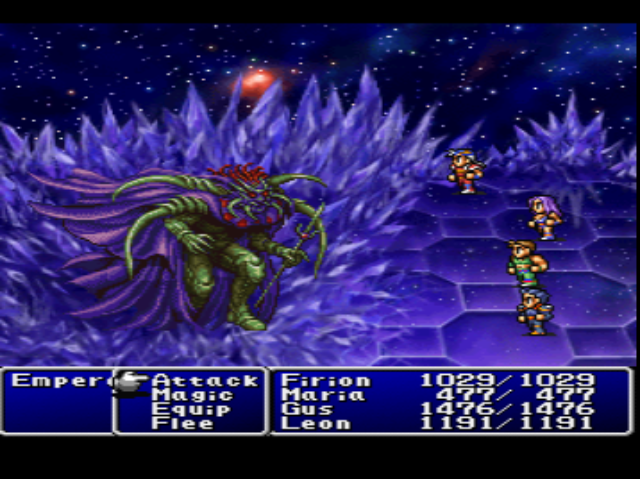 The final boss is tough but very easy to beat quickly with an exploit.
There is one other thing that got tossed after FFII and never saw the light of day again, and that is the keyword 'memorisation' system, where you can grill NPCs for information by throwing various special phrases at them (and usually get nothing more than a "?" in response) and occasionally pick up new words to ask. It's not a terrible idea, but they obviously stopped bothering with it quickly. FFII is a bit more of an interesting curiosity than FFI, but the masses were right; it's not particularly good.
Kept my attention for: A week and a bit
Did I finish it?: No
Overall: 4/10
That's it for Origins. A bit of a waste of money, and I feel sorry for any poor sap who picked this up thinking he was about to get two more Final Fantasy VIIs for the price of one. No, they'd have to wait for FFXII, and be disappointed all over again.